Colorful Christmas Tree Decorations: 31 Proven Ways to Mix Color Boldly
A colorful tree fails or sings on one thing: control. Colorful christmas tree decorations work when the colors follow a ratio, a placement map, and a finish system, so the tree looks curated instead of chaotic. This guide gives you the exact ratios designers use, from classic rainbow trees to jewel-tone and candy themes, with counts per foot of tree.
As professional interior designers consistently find, multicolor trees read as intentional when one color dominates at about 60 percent, a second supports at 30, and accents land at 10, with finishes repeated evenly across all three. Pick your palette, count your ornaments by color before you hang one, and build the boldest tree on the street.
Before You Begin: 3 Foundation Steps for Colorful Christmas Tree Decorations
1. Choose a 60-30-10 Color Ratio and Write It Down

credit: @fancy.flamingo.design
Every successful colorful tree obeys one ratio. Assign 60 percent of ornaments to your dominant color, 30 percent to the supporting color, and 10 percent to a bright accent. Write the three colors and their percentages on paper before shopping or unboxing.
The ratio converts directly into counts: on a 100-ornament tree, that is 60 dominant, 30 supporting, 10 accent. Count your existing ornaments into the three piles first; most homes discover they own 90 percent accent colors, which is exactly why their trees looked random. Buy only what the ratio is missing.
2. Establish Ornament Counts Per Foot of Tree Height

credit: @landersph
Guessing counts produces bare tops and crowded bottoms. Use a density standard: about 20 ornaments per foot of tree height for a full colorful look, scaled by the ratio. A 7-foot tree takes roughly 140 ornaments in total.
Count by color into the ratio piles from Tip 1 at the same time. Large statement ornaments count double in visual weight, so subtract one standard ornament for each oversized piece. Write the final counts on the storage box for next year.
| Tree Height | Total Ornaments | Dominant 60% | Support 30% | Accent 10% |
|---|---|---|---|---|
| 5 feet | 100 | 60 | 30 | 10 |
| 6 feet | 120 | 72 | 36 | 12 |
| 7 feet | 140 | 84 | 42 | 14 |
| 8 feet | 160 | 96 | 48 | 16 |
3. Group Ornaments by Finish as Well as Color

credit: @livingwellfairhope
Color is only half the system. Sort each color pile into three finishes, matte, shiny, and glitter or textured, and hang finishes in the same proportions at every height. A tree with all glitter at the top and all matte at the bottom looks like two trees stacked.
Aim for roughly equal thirds of each finish inside each color. Shiny finishes belong slightly deeper in the branches where they catch light through the green. This sort takes ten minutes and upgrades the whole tree more than any single purchase.
| Finish | Share Per Color | Best Depth |
|---|---|---|
| Matte | One-third | Outer branches |
| Shiny | One-third | Mid-depth |
| Glitter or textured | One-third | Mixed, sparingly at tips |
Color Palette Systems for a Colorful Christmas Tree
4. Build a Classic Rainbow Tree in Spectrum Order

credit: @rrscobey
The rainbow tree works when colors follow the spectrum, not randomness. Arrange reds at the top transitioning through orange, gold, green, blue, and violet toward the bottom, or band the colors in horizontal rings. Order is the entire difference between rainbow and mess.
Blend each band's edge with a row of mixed neighboring colors so transitions melt instead of stripe. Keep ornament sizes similar across bands so color, not size, carries the pattern. White lights only; colored lights fight the spectrum you just built.
5. Create a Jewel-Tone Tree With Deep Saturated Colors
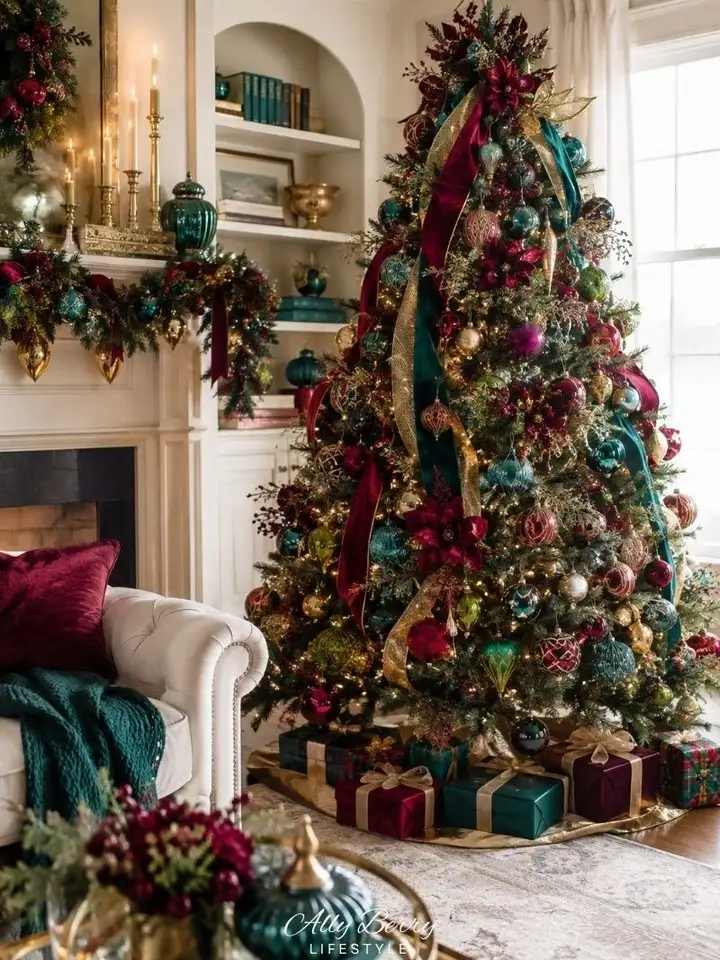
credit: @allyberrylifestyle
Jewel tones deliver luxury at any budget. Choose emerald, sapphire, ruby, and amethyst in equal-ish shares with gold as the unifying metal. Deep colors need warm light and dark green branches to glow against, so this palette suits full, dark trees.
Hold the four jewel colors within 10 percent of each other so no single jewel dominates. Gold ribbon or gold bead garland threads the palette together visually. Jewel tones photograph dramatically at night and softly by day, the most forgiving palette in this guide.
6. Use a Candy Theme With Pastels and White

credit: @thesagegoddess
Pastel candy trees trade depth for delight. Build on a white or flocked tree with pink, mint, baby blue, and lavender ornaments in soft finishes, plus white as the base color. Candy themes need the lightest tree you can get; dark green swallows pastels.
Add a few clear iridescent pieces to mimic sugar sparkle under lights. Keep metal accents silver or white, never gold, which browns the pastel read. This is the children's favorite palette and the one that sells a nursery or playroom tree instantly.
| Candy Color | Share |
|---|---|
| White base pieces | 40 percent |
| Pink | 20 percent |
| Mint and baby blue | 25 percent combined |
| Lavender plus iridescent | 15 percent combined |
7. Build a Retro Tree With Saturated Primary Colors

Retro trees celebrate the aluminum-era palette: true red, cobalt, kelly green, and bright yellow at full saturation, with silver tinsel and large bulbs. Even shares of the four colors plus silver as the metal give the authentic vintage read.
Large ornaments suit this palette; retro reads best at bold scale. Add a silver star topper and skip ribbon entirely, since tinsel does the vertical work. One retro tree in a modern room becomes the room's whole personality for December.
8. Create an Ombre Tree That Fades From Dark to Light

credit: @jazzy_christmas
Ombre trees fade one color family from deep at the bottom to pale at the top. Choose a single hue, blue, pink, or red, and sort its ornaments into five shade steps. The fade needs at least 60 percent of the ornaments in the chosen family, so this palette rewards collectors.
Place shade steps by thirds of the tree, blending each boundary with mixed shades. Silver or clear accents only; a second hue breaks the fade. Ombre is the most photographed style in this guide because the gradient reads from across any room.
9. Layer a Metallic Rainbow With Gold as the Base

credit: @nataldeimpacto
Metallics give rainbow color a grown-up frame. Use gold ornaments as the 50 percent base, then add four to five jewel or bright colors in equal accent shares. The metal base unifies colors that would otherwise argue.
Keep every accent color in the same finish family, all shiny or all matte, so gold stays the only texture story. Metallic trees suit evening rooms and dining spaces where candlelight doubles the metal. Silver works as the base for cool-toned homes.
| Layer | Share |
|---|---|
| Gold base | 50 percent |
| Four to five accent colors | 10 percent each |
| Accent finishes | One family, all matching |
| Lights | Warm white only |
You might also enjoy how to decorate a christmas tree, which pairs beautifully with the ideas in this section.
For even more inspiration, explore our guide to pink christmas tree.
If you want to dig deeper into this look, The Most Eco-Friendly Christmas Tree? A Living One. from Bob Vila is a good next read.
Placing Ornaments on a Colorful Christmas Tree
10. Place the Dominant Color First, Evenly Over the Whole Tree

credit: @tnorman23
Order of hanging decides the result. Hang all dominant-color ornaments first, spread evenly top to bottom and around all sides, before any other color touches the tree. The dominant color becomes the tree's fabric; later colors are its pattern.
Use the clock method: divide the tree into quarters and give each quarter the same count before moving on. Step back after this layer; any gap now gets covered by later colors, any clump stays visible forever. Fix clumps at this stage, not at the end.
11. Add the Supporting Color in the Gaps Between Dominant Pieces

The supporting color fills the dominant layer's spaces. Hang each supporting ornament in a visible gap, slightly deeper in the branches than its dominant neighbors. The depth difference creates the layered richness colorful trees are loved for.
Keep the supporting count honest to the ratio; enthusiasm at this layer steals the accent's share. Rotate the tree or walk around it every ten pieces so the back gets the same treatment. A tree decorated from one side only announces it from the doorway.
12. Scatter Accent Ornaments Sparingly at the Outer Tips

Accents are exclamation points: few and bright. Place accent ornaments only on outer branch tips, spaced wide and unevenly, about one per square foot of tree surface. Their scarcity is exactly what makes the eye find them.
Choose the accent in the palette's brightest or most contrasting color. If accents start covering more than a tenth of the visible tree, remove pieces rather than adding balance elsewhere. Photograph the tree; accents should pop in the photo, not cover it.
| Layer | Placement Depth | Share |
|---|---|---|
| Dominant color | Outer and mid branches | 60 percent |
| Supporting color | Mid-depth, in gaps | 30 percent |
| Accent color | Outer tips only | 10 percent |
| Oversized pieces | Mid-depth, count double | Within dominant share |
13. Hang Oversized Ornaments Deep for Color Blocks

credit: @johnderiancompany
Big ornaments create the color blocks that read from across the room. Place oversized pieces, 5 inches and up, deep in the branches at the tree's middle band, in the dominant or supporting colors only. Depth keeps their scale elegant instead of comic.
Wire oversized ornaments to branches; their weight defeats thread loops. Three to five blocks per tree side is the full quota. Accent colors never go oversized, or the 10 percent share visually doubles.
14. Use Inexpensive Filler Balls to Hold the Ratio

credit: @ioana_b_nails
Ratios survive on cheap ammunition. Buy matte filler balls in your dominant and supporting colors in bulk and use them to fill every thin spot without touching the accent count. Filler carries the color field so feature ornaments can perform.
Filler belongs at the back and deep inside, where only its color shows, never its price. One bulk box of 50 in the dominant color serves a tree for years. Replace broken feature ornaments from the filler box's colors while you shop for their true replacements.
15. Create Color Zones on Multi-Sided Trees in Open Rooms

credit: @schoolhousesalvage
Trees seen from all sides need zoning. Divide an open-room tree into three or four vertical faces and give each face the full ratio treatment independently. Every viewpoint then sees a complete composition, not the back of one.
Mark face boundaries with the ribbon or garland lines so zones stay readable while you work. Rotate a tree on its stand during decorating if it has one; otherwise walk the full circle every layer. The front-door view and the sofa view both deserve a finished face.
| Point | Rule |
|---|---|
| Faces | 3 to 4 vertical zones |
| Each face | Full 60-30-10 treatment |
| Boundaries | Ribbon or garland lines |
| Check | Walk the full circle per layer |
For a related look, take a look at christmas tree ornaments and borrow the details that fit your space.
Lights, Ribbon, and Toppers for Colorful Trees
16. Choose White Lights to Let Ornament Color Lead

credit: @julianajuliana6632
On a colorful tree, light is the servant, not a second palette. Warm white lights at about 100 bulbs per foot unify every color scheme in this guide. Colored lights shift ornament colors unpredictably and collapse careful ratios into noise.
The single exception is a deliberately retro tree, where large colored bulbs are part of the historical palette. Test one strand of any colored light against your ornaments before committing the tree. If the ornaments change color under it, the light goes back in the box.
17. Add Ribbon in the Dominant or Metal Color Only

credit: @baby_nxalati
Ribbon is a color too, and it must join the ratio. Choose ribbon in the dominant color or the palette's metal, never a new hue, and run it as vertical cascades or one spiral. Ribbon typically covers 10 to 15 percent of the visible tree, so count it inside the dominant share.
Wired ribbon holds cascades in place all season. Cut lengths of 3 feet and tuck each deep at the top. A ribbon in an unplanned color is the fastest way to break a palette, so shop ribbon with the ratio note in hand.
| Element | Color Rule |
|---|---|
| Ribbon | Dominant color or palette metal |
| Garland | Metal or dominant color |
| Tree skirt | Neutral or dominant color |
| Topper | Metal, dominant, or accent, one only |
18. Place a Garland That Threads the Colors Together

credit: @darling_collected
A bead or ball garland in the metal color stitches a colorful tree into one piece. Spiral it once at a gentle angle over the ornament layers, letting it cross every color zone. The continuous line gives the eye a path through the color.
Keep the spiral's drop even, about 12 inches per turn, checked from the front. Metal garlands also rescue a tree whose ratio drifted, by adding a unifying layer on top. Add the garland after ornaments, never before, so it sits on the color instead of under it.
| Point | Standard |
|---|---|
| Garland color | The palette's metal |
| Turns | One spiral, 12-inch drop per turn |
| Order | After ornaments, on top |
| Job | One line crossing every color zone |
19. Choose a Topper That Names the Palette

credit: @a_sprinkle_of_jo
The topper is the palette's title. Pick a star, bow, or finial in the metal or the dominant color, sized to the tree, roughly 1 inch of topper height per foot of tree. An accent-color topper also works when the accent needs one strong final note.
Avoid novelty toppers on curated palettes; they introduce a theme the ratio never approved. Secure the topper with a cone or clip so it stands straight in every photo. The topper goes on last and comes off first, always.
20. Add Colored Picks and Sprays for Texture Pockets

credit: @cornishware
Picks add the feathery texture balls cannot. Insert berry picks, glitter sprays, or colored feather picks in small pockets of three, in the supporting or accent colors, at mid-depth. Pockets of texture break up ball monotony without new colors.
Limit pockets to about one per foot of tree height. Bend pick stems into hooks so they grip branches instead of sliding out. Glitter picks shed; place them after all other decorating is finished.
21. Use a Tree Skirt in a Neutral That Grounds the Color

credit: @alisonmartino
The skirt is the tree's floor line and should calm, not compete. Choose a skirt in a neutral, cream, burlap, or the room's wood tone, with at most a trim in the dominant color. A loud skirt steals the bottom band of ornaments from view.
Match wrapped gift paper to the palette and the skirt zone becomes part of the design. A skirt 48 inches across suits most trees up to 8 feet. Collars in metal finishes work for the metallic palettes in place of fabric.
| Point | Choice |
|---|---|
| Skirt color | Neutral, trim in dominant max |
| Diameter | 48 inches for trees to 8 feet |
| Gift wrap | Matched to the palette |
| Metallic palettes | Metal collar instead of fabric |
If this style appeals to you, christmas tree decorations offers more ways to carry the same festive mood through your home.
Styling a Colorful Tree to Suit the Room
22. Match the Tree's Boldest Color to One Room Accent

credit: @balsamhill
A colorful tree joins a room through one handshake. Repeat the tree's dominant color in exactly one room accent, cushions, a throw, or a table runner, and leave the rest of the room as it is. One echo integrates the tree; five echoes redecorate the room around it.
Choose the accent you see in the same glance as the tree, usually the sofa. Swap the accent back in January with the tree's teardown. This one-move coordination is why bold trees look at home in calm rooms.
23. Photograph the Tree and Audit the Ratio From the Photo

credit: @pier1
Eyes forgive; cameras audit. Photograph the finished tree from the room's main viewpoints and check the photo for ratio drift, clumps, and bare zones. Adjust until the photo shows 60-30-10 clearly, because photos are how the tree will be remembered.
Convert one photo to black and white; clumps and bare zones show as grey patches even when colors hide them. Move ornaments in the photo's problem spots only. Take the audit photo at night with tree lights on, the tree's main performance condition.
24. Add Scent and Music Instead of More Color

credit: @anelsdecorations
When a tree feels unfinished, the missing layer is usually not visual. Add pine scent near the tree and the room's holiday music, and the colorful display suddenly feels complete. Sensory layers finish rooms without touching the ratio.
This rule rescues decorators from the last-minute ornament run that breaks every palette. If the photo audit passes, the tree is done, whatever the shops are selling. Write DONE on the ratio note and put it in the storage box.
| Layer | Addition |
|---|---|
| Scent | Pinecones or a warmer near the tree |
| Sound | The room's holiday playlist |
| Ornaments | None, the ratio is closed |
| Proof | Photo audit already passed |
25. Switch Off Half the Room's Other Lights at Night

credit: @xavi.home
Colorful trees perform in contrast. Dim or switch off competing room lights in the evening so the tree's colors carry the room alone. One lamp at low level plus the tree is the classic evening arrangement.
Put the room's lamps on the same timer logic as the tree for an automatic evening scene. Guests will gravitate to the tree's side of the room without knowing why. Daytime needs no help; window light flatters every palette in this guide.
Another helpful next step is our roundup of blue christmas decorations.
You will also find plenty of inspiration in Tinsel Christmas Trees: 8 Designer Styling Tips & History at Apartment Therapy.
Maintenance and Long-Term Habits for Colorful Christmas Trees
26. Store Ornaments Sorted by Color and Finish

credit: @vintage_rescues
Teardown sorting decides next year's speed. Pack ornaments into divided boxes sorted by color first and finish second, exactly as Tip 3 grouped them. Label each box with its color's percentage so the ratio rebuilds itself during setup.
Keep one small mixed box for repairs and singles that lost their group. Tissue between glitter finishes stops the sparkle transfer that dulls matte pieces. Boxes stored by color stack in ratio order, dominant at the bottom.
| Box | Contents |
|---|---|
| Box 1 | Dominant color, all finishes |
| Box 2 | Supporting color, all finishes |
| Box 3 | Accents, toppers, picks |
| Small box | Repairs, singles, spare filler |
27. Replace One Broken Color Group Before Next Season

credit: @cozyxmasvibess
Audit colors at teardown, not in December. If one color lost pieces to breakage, note the deficit against its ratio count and replace it during January sales. Next setup then starts from a complete system instead of a shortage.
January sales cut ornament prices by half or more, so the audit pays for itself. Photograph the note into the setup album so the list survives the year. Never replace with a new color on sale impulse; the ratio approves purchases, not the discount.
| Step | Timing |
|---|---|
| Count deficits by color | At teardown |
| Write the list | Same day, photographed |
| Buy replacements | January sales |
| New colors | Never on impulse |
28. Remove Dust From Ornaments With a Soft Glove

Color shows dust faster than green hides it. Wipe ornaments in place weekly with a soft microfiber glove, working top down, and shake glitter picks outside once mid-season. Five minutes keeps jewel and pastel palettes reading at full saturation.
Never spray cleaner near a decorated tree; droplets spot glitter and matte finishes permanently. A glove beats a duster because it wraps each ball in one pass. Dust day doubles as the weekly check for slipped ornaments and dead light sections.
29. Add One New Color Only by Rebalancing the Ratio
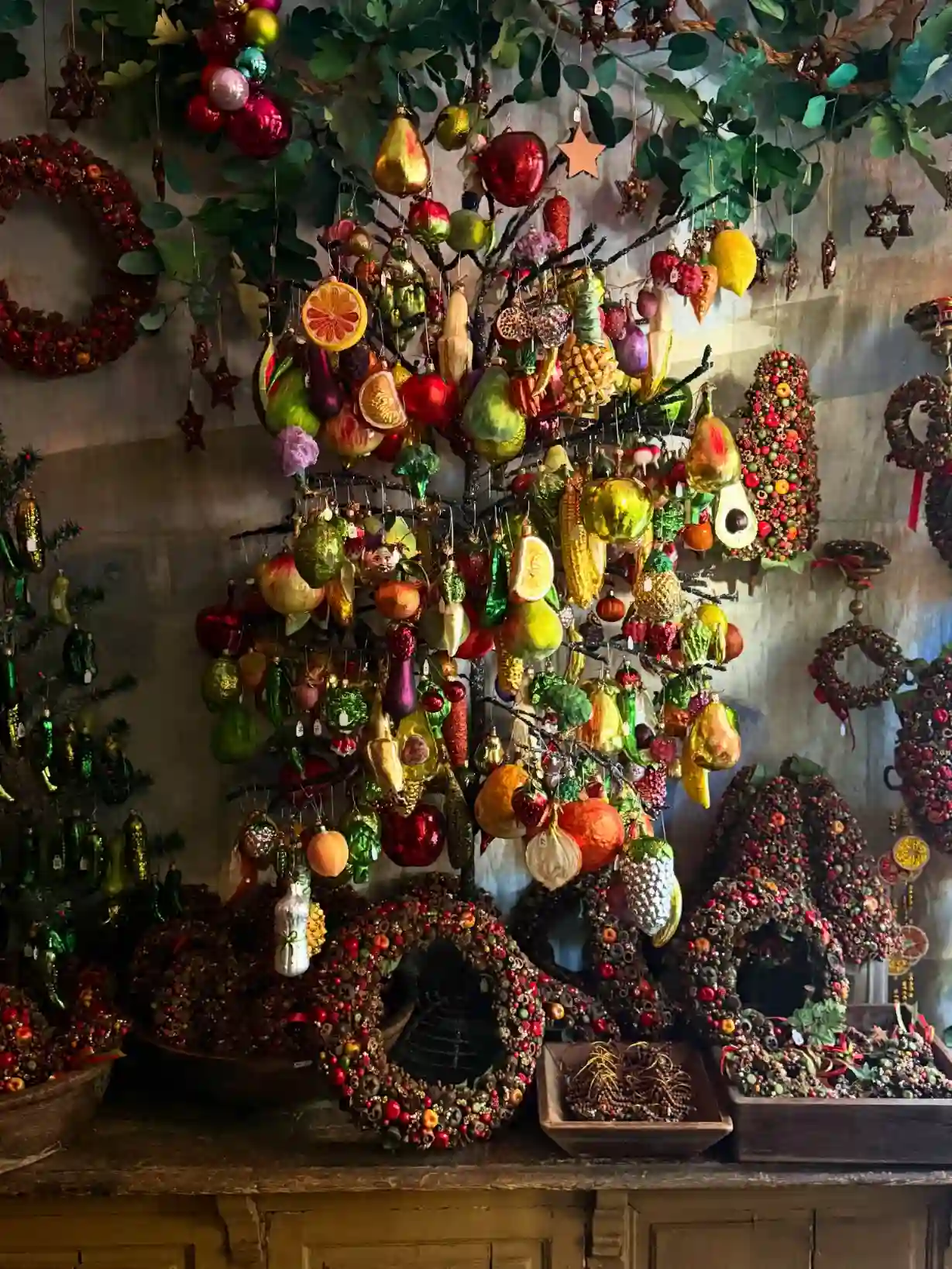
credit: @johnderiancompany
Palettes evolve by decision, not drift. To introduce a new color next year, promote it deliberately: it takes share from the existing colors and the ratio gets rewritten on paper first. A color that sneaks in as gifts and impulse buys breaks the system silently.
Swap, do not stack: a new accent replaces the old accent, which moves to filler or donation. Keep the three-color ceiling unless you are rebuilding as a true rainbow or jewel palette. The written ratio is the tree's constitution; amend it properly.
30. Rotate Feature Ornaments to the Front Each Year

credit: @raynbowcrowstudios
Feature pieces age unevenly in storage and light. Mark each year's front-facing feature ornaments with a small dot of tape on their caps and rotate next year's set from the back of the box. Rotation spreads light fade and gives the tree a fresh face with the same collection.
Photograph each year's finished tree; the album shows the rotation working across seasons. Faded pieces retire to the back faces or the filler box with dignity. A rotated collection looks newly bought for about five years longer than a static one.
| Point | Rule |
|---|---|
| Mark | Tape dot on this year's front caps |
| Next year | Undotted pieces come forward |
| Faded pieces | Retire to back faces or filler |
| Record | One photo per year in the album |
31. Remove Ornaments in Reverse Color Order at Teardown

Teardown reverses setup: accents first, then supporting, then dominant, then garland, ribbon, and lights. Reverse order keeps the ratio piles pure as they return to their boxes and protects fragile accents from the big sort's traffic.
Count each color back into its box against the ratio note as you go. Discrepancies found now become January's shopping list from Tip 27. A counted teardown takes twenty extra minutes and saves an hour next December.
| Order | Layer Removed |
|---|---|
| First | Topper and accents |
| Second | Supporting color |
| Third | Dominant color and oversized |
| Last | Garland, ribbon, lights |
To keep building on this theme, see how front porch christmas decor ideas handles a similar look in a different way.
Common Colorful Christmas Tree Mistakes That Break the Palette
| Mistake | Why It Fails | Do This Instead |
|---|---|---|
| Equal shares of every color | No color leads, so the tree reads as noise | 60-30-10 ratio written down first |
| Colored lights over colored ornaments | Colors shift and ratios collapse visually | Warm white lights at 100 per foot |
| Ribbon in an unplanned new color | A fourth color enters at 15 percent scale | Ribbon in dominant or metal only |
| All accents clumped in one zone | The eye reads a mistake, not a highlight | Accents at outer tips, one per square foot |
| Finishes sorted unevenly by height | Tree looks like two designs stacked | Equal finish mix at every height |
| Impulse colors added mid-season | The palette drifts beyond recognition | New colors only by rewritten ratio |
Colorful Christmas Tree Decorations by Situation and Style
Families Letting Children Decorate Freely
Give children the supporting-color layer within a parent-built dominant base. The ratio survives their joy because the structure was set first, and their placements sit inside a system that forgives everything. Shatterproof ornaments in the boldest colors become the kids' official collection.
Small Trees in Apartments
Scale counts, not ratios: a 4-foot tree takes about 80 ornaments at the same 60-30-10 split. Small trees read best with slightly larger ornaments and one metal. Keep the palette to three colors maximum, since small surfaces show drift faster.
Formal Rooms That Want Color Without Chaos
Choose the jewel-tone or metallic-base palette, hold accents to gold, and keep every finish matte or satin. Formal rooms take color best at low shine and deep saturation. The tree becomes art rather than party, which is the formal version of colorful.
Photo-First Homes and Social Sharing
Build the ombre or rainbow, audit by photograph from Tip 23, and decorate the camera side to full standard first. Gradients and spectra read best in photos because the pattern survives a flat image. Take the hero shot at night with room lights low.
Frequently Asked Questions
How do I make a colorful Christmas tree look classy instead of messy?
Follow the 60-30-10 ratio, repeat finishes evenly at every height, and use warm white lights only. Mess comes from equal shares and mixed light temperatures, not from color itself. A written ratio and a photo audit keep any palette looking curated.
What should you not do when decorating a colorful tree?
Never add a color outside the written palette, hang ribbon in an unplanned hue, or use colored lights over multicolor ornaments. Each move breaks the ratio that makes the tree readable. Also never clump accents; they work by scarcity and spacing.
How can I build a colorful tree on a small budget?
Buy bulk matte filler balls in your dominant and supporting colors, then spend the rest on a few feature ornaments and the topper. Filler holds the ratio at pennies per piece. A full 7-foot colorful system starts around $45 using filler economics.
How do colorful decorations work on a small tree or in a small room?
Keep the same ratio and reduce the count: about 20 ornaments per foot still applies, so a 4-foot tree needs roughly 80. Choose slightly larger ornaments so the colors read at small scale. One metal only keeps a small tree from fragmenting.
Which is better for a colorful tree, a rainbow palette or three colors?
Three colors at 60-30-10 for most homes: it reads clearly from every distance and is easy to maintain. Rainbow works when you commit to spectrum order and similar sizes. Both fail without a system; both succeed with one.
How often should a colorful tree be refreshed during the season?
Dust ornaments weekly with a microfiber glove and check the photo audit once mid-season for slipped pieces. Colors themselves need no refresh when the ratio holds. Replace a dead light section immediately, since dark zones distort the color balance.
Do colorful Christmas tree decorations really work in a formal home?
Yes, in the jewel-tone or metallic-base palettes with matte and satin finishes. Deep saturation and low shine read as luxury, not noise. Hold the accent to one metal and the formal room stays formal while the tree glows.
How much do colorful Christmas tree decorations cost?
Around $45 starts a complete 7-foot system with bulk filler, feature ornaments, ribbon, and a topper, based on the counts in this guide. Jewel and metallic palettes cost slightly more per feature piece. Later years cost almost nothing because the sorted boxes return whole.
How long do colorful tree decorations last, and how should they be stored?
Quality ornaments last ten seasons or more stored sorted by color and finish in divided boxes with tissue over glitter. Filler balls are the consumable, replaced as they break. Label boxes with their ratio percentages so every setup rebuilds the palette automatically.
Conclusion
Colorful christmas tree decorations are a system wearing a party dress: a written 60-30-10 ratio, finishes repeated evenly, white light, and a photo audit before you call it done. Choose your palette this week, count your ornaments into their piles, and hang in layer order. The result is the boldest tree on the street, and the most controlled one too.



4 Comments