

Bedroom Ideas: 24 Proven Ways to Add Style and Comfort
Bedroom ideas only work when they follow a sequence: layout first, color second, bedding third, lighting fourth, finishing touches last. Skip the order and you buy pieces that fight each other.
As professional interior designers consistently find, a bedroom succeeds or fails on the bed wall and the lighting plan before a single accessory is chosen.
This guide gives you 24 steps in the exact order to complete them. Each one includes the measurements, materials, and rules you need to act today. Whether you want cozy bedroom ideas, small bedroom ideas, or master bedroom ideas, the same system applies.
Before You Begin: 4 Foundation Steps for Better Bedroom Ideas
1. Create a Furniture Layout Map With Exact Measurements

Guessing at furniture placement wastes money. Every oversized bed or dresser that arrives and does not fit becomes a return fee or a permanent traffic jam. Measuring first prevents both.
Measure the room’s length, width, and window and door positions. Then mark every furniture footprint on the floor with painter’s tape before buying or moving anything. Walk the tape layout for one full day to test the traffic flow.
Match your bed size to the room before anything else. A king bed in a room under 12×12 feet leaves almost no walking space.
| Bed Size (inches) | Minimum Comfortable Room Size |
|---|---|
| Twin (38×75) | 7×10 feet |
| Full (54×75) | 9×10 feet |
| Queen (60×80) | 10×10 feet |
| King (76×80) | 12×12 feet |
You will also find plenty of inspiration in Relaxing bedroom ideas: 10 restful and chic design ideas at Homes & Gardens.
To keep building on this theme, see how home decor ideas handles a similar look in a different way.
2. Choose a Three-Color Palette Before Buying Anything

Random colors create visual noise. A bedroom with six unrelated shades never settles into a cohesive look, and the eye has no place to rest.
Apply the 60-30-10 rule. Use one color for 60% of the room (walls and large surfaces), a second for 30% (bedding, curtains, rug), and a third for 10% (pillows, art, accessories). Pull all three from a single inspiration piece, such as a rug or a piece of art.
This rule eliminates the guesswork on every purchase after it. If an item does not match one of the three colors or a neutral, it stays out.
3. Remove Every Item That Does Not Belong

Clutter is the single most common reason a styled bedroom still feels unfinished. Visual noise hides the design work you have already done.
Empty every surface into a box, then return only what you use daily or genuinely love. Move laundry, paperwork, and gym gear out of the bedroom entirely. Never use the floor or the chair as storage.
Use these limits to keep surfaces permanently clear:
| Surface | Maximum Items Allowed |
|---|---|
| Nightstand top | 3–4 items |
| Dresser top | Cover no more than one-third of the surface |
| Floor | Nothing within the 24-inch walkways |
| Accent chair | Empty, or one folded throw only |
4. Establish the Bed as the Single Focal Point

A bedroom with competing focal points feels chaotic. The bed is the largest object in the room, so it must lead the visual hierarchy.
Center the bed on the wall facing the door, with equal space on both sides. Keep everything else on that wall secondary in scale and color. Move the dresser, desk, and tall shelving to other walls.
The result is a room that reads as organized the moment you walk in, because the eye lands on the bed first and everything else supports it.
Bedroom Layout and Furniture Placement Ideas
If you want to dig deeper into this look, 35 bedroom ideas: for a dreamy, elevated and chic sleep space from Homes & Gardens is a good next read.
5. Place the Bed on the Longest Solid Wall

A bed pushed against a window or door wall feels unstable. Drafts, glare, and a blocked entry flow follow.
Position the headboard against the longest wall that has no window or door. Keep the headboard 0–1 inch from the wall. Leave the window on a side wall so light arrives from the side instead of directly behind the pillows.
A solid wall behind the bed also gives your headboard and wall decor a clean backdrop, which is the foundation of the whole room’s look.
You might also enjoy wall decor ideas, which pairs beautifully with the ideas in this section.
6. Arrange Matching-Height Nightstands Beside the Mattress
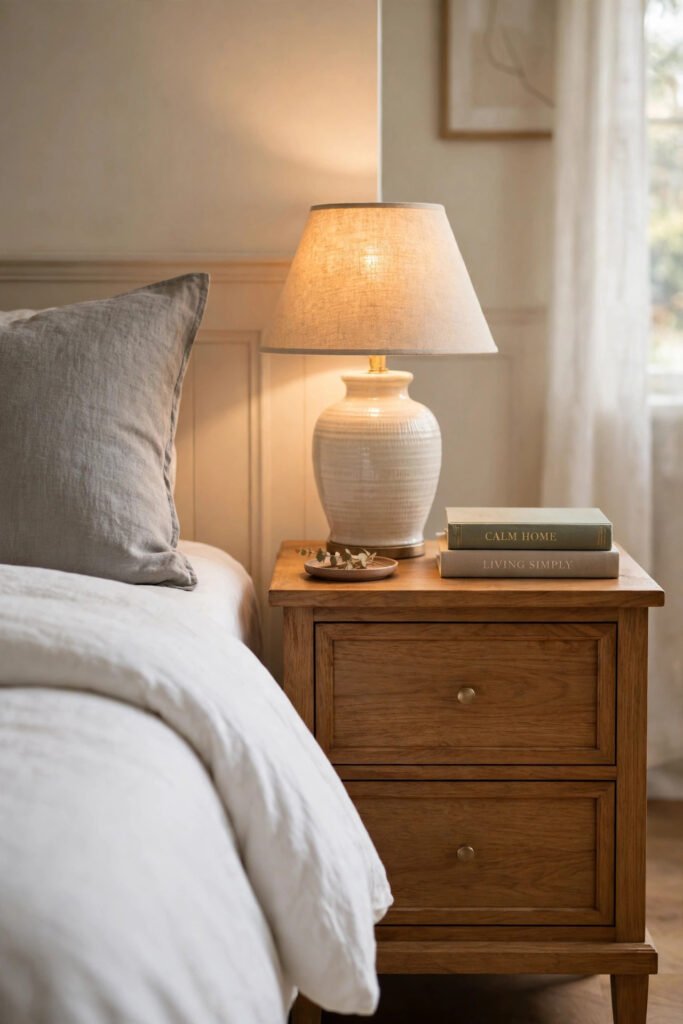
Mismatched nightstands break the symmetry that makes a bed look finished. A table sitting 6 inches below the mattress makes every lamp feel awkward.
Measure from the floor to the top of your mattress. Choose nightstands whose tops sit within about 2 inches of that height. Place them within 2 inches of the bed’s edge, with a matching pair on each side.
Matching heights make the lamps sit at consistent levels, which creates immediate balance across the headboard wall.
| Mattress Top Height | Nightstand Height Range |
|---|---|
| 20–22 inches | 18–24 inches |
| 23–25 inches | 22–27 inches |
| 26–28 inches | 25–30 inches |
| 29 inches and above | 28–32 inches |
7. Add a Bench at the Foot of the Bed

An empty foot of the bed leaves the layout unresolved. The bed ends abruptly, and you have no place to sit while dressing.
Choose a bench between two-thirds and the full width of your bed. For a queen bed, that is 40–60 inches. Keep the seat height at 17–20 inches and the depth at 14–18 inches. Leave at least 24 inches between the bench and any dresser or wall.
The bench anchors the foot of the bed and gives you a visible landing spot for folded throws, which completes the bed’s silhouette from the doorway.
8. Limit Furniture to Preserve 24-Inch Walkways
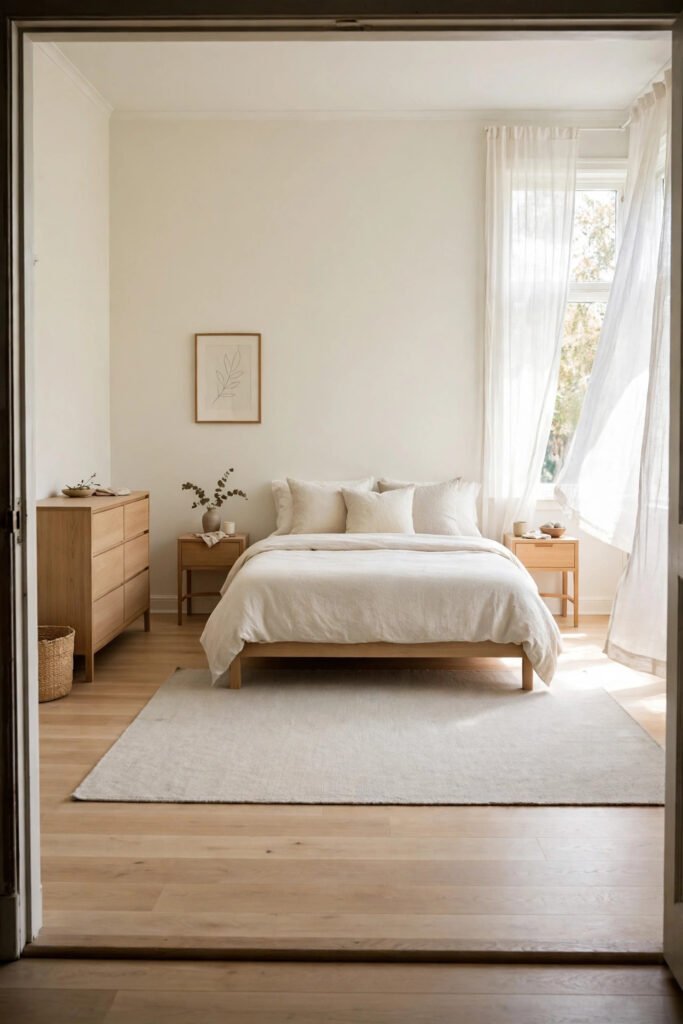
Overfilled bedrooms feel smaller than they are. You lose breathing room, and every trip to the closet becomes an obstacle course.
Keep at least 24 inches of clear floor along both sides and the foot of the bed. Remove any piece that violates this clearance. A single dresser and two nightstands are enough furniture for most bedrooms under 12×12 feet.
Use these clearances as hard limits:
| Location | Minimum Clearance |
|---|---|
| Along each side of the bed | 24 inches |
| Between bed foot and dresser | 36 inches |
| Dresser drawer pull-out zone | 36 inches |
| In front of the closet door | 30 inches |
Bedding and Layering Ideas for a Cozy Bedroom
9. Layer Bedding in Three Tiers: Sheet, Duvet, Throw

A flat, single-layer bed looks like a hotel room with no personality. Layers create the depth that makes cozy bedroom ideas actually read as cozy.
Start with a smooth sheet. Add a duvet and fold it back one-third of the way down from the headboard. Place a throw across the bottom third of the bed. Choose all three layers from your three-color palette.
The fold creates a visible band of contrast, which is why a layered bed looks styled even before you add a single decorative pillow.
| Layer | Specification |
|---|---|
| Sheet | Cotton percale or sateen, 250–400 thread count |
| Duvet and cover | Fold back 12–18 inches from the headboard side |
| Quilt or coverlet (optional) | Fold into a band 12 inches deep at the foot |
| Throw | 50×60 inches, folded in thirds lengthwise |
10. Use Five Pillows in Two Sizes

Too few pillows make a bed look bare. Too many bury it. Five is the number that balances function and visual weight.
Place two sleeping pillows against the headboard, two 26×26-inch euro pillows in front of them, and one lumbar pillow centered at the front. Use a solid color on the euros and a subtle pattern or texture on the lumbar.
This arrangement scales with the bed. For a twin or full, drop to three pillows: one euro pair is not needed.
| Pillow Type | Size | Quantity (Queen) |
|---|---|---|
| Sleeping pillow | 20×26 inches | 2 |
| Euro pillow | 26×26 inches | 2 |
| Lumbar pillow | 12×20 or 14×24 inches | 1 |
| Accent square (optional) | 18×18 inches | 0–1 |
11. Choose Linen or Cotton Sateen for Visible Texture

Flat polyester bedding photographs and feels cheap. Natural fibers create texture contrast that even a plain color scheme needs to look expensive.
Use linen for the duvet cover, where relaxed wrinkles add character, and cotton sateen or percale for the sheets against your skin. Wash linen before first use to soften it. Never iron it; the wrinkle is the point.
Pairing a matte textured top layer with a smooth under layer gives the bed depth in photos and in person.
12. Apply a Chunky Knit Throw at the Foot

A bare foot of the bed looks unfinished. A single heavy throw adds the texture and weight that closes the composition.
Drape the throw off-center, with one end hanging 12–18 inches over the side. Choose a throw in your accent color or a lighter neutral shade of your main color. Fold it once lengthwise before draping so the edge lies flat.
A throw that hangs off-center adds deliberate asymmetry, which keeps a symmetrical bed from looking stiff.
| Throw Material | Approx. Weight | Best Season |
|---|---|---|
| Chunky wool-blend knit | 4–5 lbs | Winter |
| Cotton waffle weave | 1.5–2 lbs | Spring and fall |
| Linen-cotton blend | 1–1.5 lbs | Summer |
| Faux fur | 3–4 lbs | Winter accent |
Bedroom Lighting Ideas for Warm Ambiance
13. Install Dimmable Bedside Lamps at Shoulder Height

Overhead lighting flattens a bedroom and glares at bedtime. Lamps placed too low light the nightstand instead of the book in your hands.
Choose a lamp 24–30 inches tall including the shade, so the bottom of the shade sits at about shoulder height when you sit up in bed. Add an inline or smart dimmer. Use a matched pair, one on each side.
Dimmable bedside lamps give you reading light at 100% and a soft glow at 20%, so one fixture handles both jobs.
14. Add 2700K Warm Bulbs Throughout the Room

Cool white bulbs make a bedroom feel like a clinic. Color temperature controls the mood more than any fixture does.
Check the package for 2700K or lower, and replace every bulb in the bedroom with the same color temperature. Mixing 2700K and 4000K bulbs makes the room look patchy. Aim for 400–800 lumens per lamp.
The result is a consistent, golden light that makes your wall color and bedding look richer at night.
If this style appeals to you, living room decor ideas offers more ways to carry the same look through your home.
For a related look, take a look at bathroom decor ideas and borrow the details that fit your space.
15. Hang Blackout Curtains From Ceiling to Floor

Short curtains hung at the window frame make the window and the ceiling look smaller. They also leak light at the edges.
Mount the rod 4–6 inches above the window frame or just below the ceiling. Extend it 8–12 inches beyond each side of the frame. Hang panels so the hem hovers a half inch above the floor.
High-hung curtains lengthen the wall, and the wide extension blocks side light leaks that ruin morning sleep.
| Curtain Detail | Rule |
|---|---|
| Rod height | 4–6 inches above frame, or near ceiling |
| Rod width | 8–12 inches beyond each side of the frame |
| Panel length | Hem 0.5 inch above floor |
| Panel fullness | 2× the rod width |
16. Mount Wall Sconces to Free Up Nightstand Space
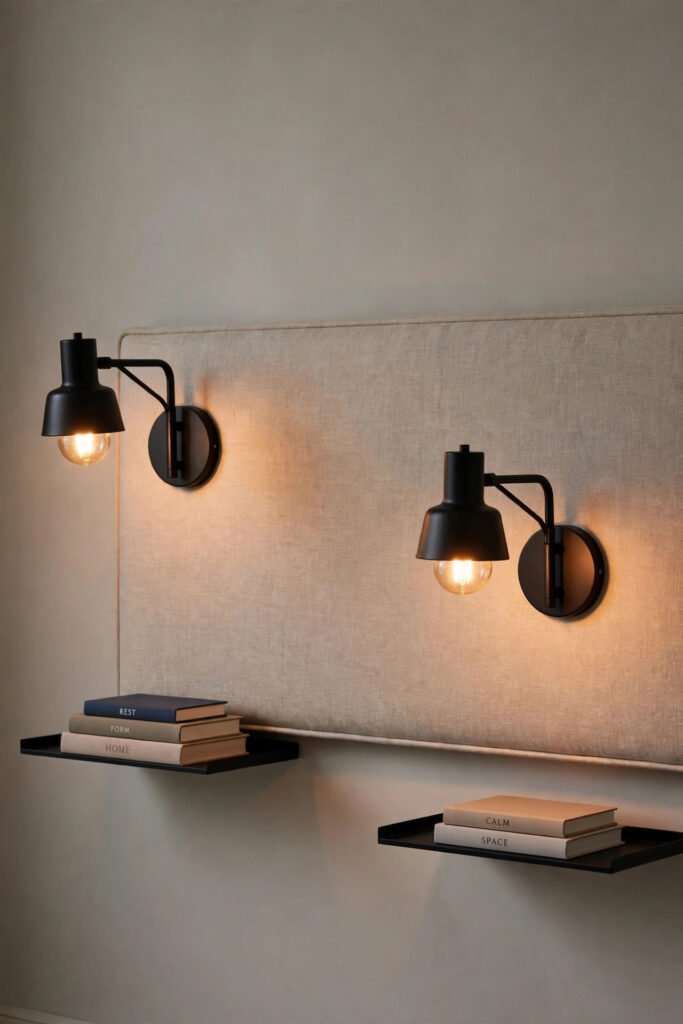
Two large lamps eat a small nightstand. In compact rooms, every inch of that surface matters.
Mount swing-arm sconces so the light source sits 24–30 inches above the mattress top. Place one 8–12 inches outside each edge of the headboard. Choose plug-in models with a cord cover if you cannot hardwire.
Sconces return the full nightstand surface to you, which is the most effective fix for small bedroom ideas on a tight footprint.
Bedroom Wall Decor and Paint Color Ideas
17. Hang Art 6–8 Inches Above the Headboard

Art hung too high floats apart from the bed. The piece and the headboard read as two unrelated objects.
Hang a single large piece or a tight gallery group 6–8 inches above the top of the headboard. Make the art 60–75% of the headboard’s width. Measure the center point first, then mark it with painter’s tape before drilling.
This spacing ties the art and the bed into one unit, which strengthens the focal point you built in Step 4.
18. Apply Muted Matte Paint in One Calm Tone

High-contrast or glossy walls keep the bedroom visually busy. A bedroom needs wall color that recedes at night.
Choose a low-saturation color: sage, warm greige, soft blue-gray, or muted clay. Apply matte or flat paint on the walls, which hides surface flaws and absorbs light. Paint the ceiling a half-shade lighter than the walls to lift the room.
A single calm tone gives you the quiet backdrop that every other layer in this guide depends on.
| Paint Finish | Approx. Sheen | Best Bedroom Use |
|---|---|---|
| Flat or matte | 0–5% | Walls, ceilings |
| Eggshell | 10–25% | Walls needing easy cleaning |
| Satin | 25–35% | Trim, doors |
| Semi-gloss | 35–70% | Baseboards, window casings |
19. Build a Wood Slat Feature Wall Behind the Bed

A flat painted wall behind the bed leaves the largest surface in the room undeveloped. Wood slats add texture and structure without clutter.
Cut 1×2-inch slats and space them 0.5–1 inch apart. Mount them vertically on a painted dark backing so the gaps read as shadow lines. Extend the wall at least 12 inches past each side of the bed.
The vertical lines raise the apparent ceiling height, and the wood tone adds warmth that paint cannot match.
Bedroom Styling Ideas and Finishing Touches
20. Place a Large Mirror Opposite the Window

A dark bedroom with one window wastes the light it receives. Mirrors turn that light into a second source.
Hang or lean a mirror at least 60 inches tall directly across from the window. Angle it so it reflects daylight and a pleasant view, never the bed. Keep the bottom edge 4–6 inches off the floor if hanging.
A mirror placed this way effectively doubles the daylight in the room and increases perceived depth.
21. Style Nightstands Using the Rule of Three

A nightstand with one object looks bare, and one with eight looks cluttered. Three heights create a composed vignette.
Place one tall item (the lamp), one medium item (a book stack with a tray or dish on top), and one low or living item (a small plant or candle). Vary the heights and keep the three in a loose triangle. Leave the remaining surface open for your phone and water glass.
Odd-numbered groupings read as collected rather than staged, and the open surface keeps the vignette functional.
| Element | Height Target | Example |
|---|---|---|
| Tall | 24–30 inches (with shade) | Table lamp |
| Medium | 4–8 inches | Two books plus a dish |
| Low | 2–5 inches | Small plant, candle, or tray |
| Functional space | Remaining surface | Water glass, phone |
22. Anchor the Bed With a Rug Extending 24 Inches

A rug too small leaves the bed floating. Bare floor around the sides makes the whole room feel unanchored.
Place the rug under the bottom two-thirds of the bed so it extends 18–24 inches past each side and the foot. Keep the nightstands off the rug or fully on it, never half and half. Choose a low-pile or flatweave style so the bed frame sits level.
A properly sized rug is the fastest way to make a bed look anchored and intentional.
| Bed Size | Rug Size | Approx. Side Extension |
|---|---|---|
| Twin | 6×9 feet | 17 inches |
| Full | 8×10 feet | 21 inches |
| Queen | 9×12 feet | 24 inches |
| King | 10×14 feet | 22 inches |
Bedroom Maintenance Habits That Keep the Look Lasting
23. Switch Bedding Seasonally to Keep the Room Fresh

Winter bedding in July makes the bed hot and heavy. Swapping layers resets the room’s look without buying anything new.
Rotate between two bedding sets twice a year. Use linen or lightweight cotton from May through September, and flannel or heavier cotton with a wool or knit throw from October through April. Store the off-season set in a breathable cotton bag, never plastic.
Keeping the same color palette across both sets preserves your cohesive look while the textures change.
24. Establish a Five-Minute Nightly Reset Routine

A bedroom decays in small steps. Left alone, a styled room returns to clutter within a week.
Set a five-minute timer each evening. Spend the time on the four tasks below. Do them in the same order every night so the routine becomes automatic.
The result is a room that looks styled every morning, with no weekend deep clean needed to recover it.
| Task | Time |
|---|---|
| Smooth the duvet and straighten pillows | 60 seconds |
| Clear the nightstand to 3 items | 60 seconds |
| Put clothes in the hamper or closet | 120 seconds |
| Return the throw to the foot of the bed | 60 seconds |
Common Bedroom Decorating Mistakes That Make Rooms Feel Cramped
| Mistake | Why It Fails | The Fix |
|---|---|---|
| Rug under only the front legs of the bed, or smaller than 8×10 for a queen | The bed floats and the room looks unfinished | Use a 9×12 rug extending 18–24 inches on each side |
| Furniture pushed against every wall | Leaves a dead center and blocks flow | Keep 24 inches of walkway and float pieces where possible |
| Overhead light as the only source | Flat, glaring, and harsh at night | Add two bedside lamps and a 2700K warm bulb |
| Art hung at standing eye level above the bed | The piece floats 12–18 inches above the headboard | Hang 6–8 inches above the headboard |
Bedroom Ideas by Room Size and Situation
Small Bedrooms Under 100 Square Feet
Use a low platform bed with built-in drawers to remove the need for a dresser. Mount wall sconces to free nightstand space. Paint the walls and ceiling the same light shade to blur the room’s edges. Limit furniture to the bed, one narrow nightstand, and a wall-mounted shelf.
Rental Bedrooms With No Permanent Changes
Use plug-in wall sconces with fabric cord covers, removable peel-and-stick wallpaper behind the bed, and a large rug to hide worn flooring. Hang art with adhesive hanging strips rated for the frame weight. Replace the overhead bulb with 2700K LED and add a fabric lamp shade.
Large Bedrooms With a Sitting Area
Divide the room into two zones: a sleeping zone around the bed and a sitting zone with one accent chair and a small side table. Place a second rug under the sitting zone. Keep 36 inches of walkway between zones.
Shared or Kids’ Bedrooms
Use matching bedding in two coordinated colors so each person has an identifiable bed. Add individual wall sconces for independent reading light. Use vertical storage such as wall shelves and under-bed bins to keep the floor clear.
Frequently Asked Questions
What are the best bedroom ideas for a cozy room?
The most effective cozy bedroom ideas are layered bedding, 2700K warm lighting, a large rug under the bed, and a textured throw at the foot. These four changes alone transform the room’s feel within a single afternoon.
What should you not put in a bedroom?
Keep work desks, exercise equipment, laundry piles, and overhead-only lighting out of the bedroom. These items pull the room away from rest and make it feel like a multi-use space instead of a retreat.
How do you decorate a bedroom on a budget?
Start with free changes: declutter, rearrange the bed to the longest solid wall, and clear every surface. Then spend on the highest-impact items first: warm bulbs, a duvet cover, and a properly sized rug. Add art last.
How do you decorate a small bedroom in a rental?
Use plug-in sconces, adhesive wall hooks, a large rug, and peel-and-stick wallpaper behind the bed. Choose furniture with built-in storage and keep the palette to three colors so the room reads as larger.
For even more inspiration, explore our guide to small bedroom ideas.
What color is best for a bedroom?
Muted, low-saturation shades such as sage green, warm greige, soft blue-gray, and muted clay work best. These tones absorb light softly and keep the room calm at night.
How often should you update your bedroom decor?
Rotate bedding and throws twice a year, and refresh accessories such as pillows and art once a year. Larger changes such as paint or furniture need updating only every 5–7 years.
Do dark bedroom colors work in small rooms?
Yes, when you commit fully. Paint the walls, trim, and ceiling in the same deep shade, such as navy or charcoal, and add warm lighting. The room reads as cocooning instead of cramped.
Another helpful next step is our roundup of home decor.
How much does it cost to redo a bedroom?
A budget refresh with paint, bedding, a rug, and lamps typically costs 1,500. A full redo with new furniture, flooring, and custom curtains ranges from $3,000 to $10,000 or more, depending on your market and material choices.
How long does a duvet insert last?
A quality down or down-alternative duvet insert lasts 5–10 years with a protective cover. Wash the cover every 2 weeks and the insert once or twice a year according to the care label.
Conclusion
A well-styled bedroom comes from sequence, not from budget. Measure the room, fix the layout, set the palette, and layer the bedding. Then add lighting, wall decor, and finishing touches.
The three changes with the biggest impact are warm 2700K bulbs, a properly sized rug, and a layered bed with five pillows. Start with those, then work through the remaining steps in order.
Pick one tip from the foundation section and complete it today. A single measured, tape-marked layout changes every decision that follows.





3 Comments