
Home Office Decor: 32 Proven Ways to Build a Room That Works as Hard as You Do
Home office decor carries a double burden no other room bears: it must make its resident productive for eight hours and presentable to a camera in one second's notice, while sitting inside a home that keeps trying to reclaim it for storage. Offices that succeed treat ergonomics as the first decor layer, light and backdrop as the second, and styling as the third, with a shutdown ritual keeping the room an office by day and a room again by night. This guide builds the home office in that order, from closet conversions to full rooms, for employees, founders, and every hybrid schedule between.
As professional interior designers consistently find, home offices sustain their workers when about 80 percent of the decor budget and attention go to the body's contacts and the camera's view (chair, light, screen position, backdrop) before any ornamental spending begins. Fix the chair and the light, compose the backdrop like a portrait, and let the styling layer be the reward the working systems earn.
Before You Begin: 3 Foundation Steps for Home Office Decor
1. Choose the Office's Territory and Defend Its Border

credit: @vanessawolfhomes
The office needs a defensible border: a spare room with a door at best, a closet, alcove, or zoned corner with a screen or curtain at least, and in every case a shutdown line the household respects. Work that sprawls across the home follows its worker everywhere; work with a border can be left. Choose the territory by daylight, quiet, and distance from the household's traffic river, in that order.
A door that closes is the single most valuable office feature in any home, outranking square footage. Where no door exists, the screen, the bookcase divider, and the household treaty substitute in descending order of silence. Mark the border physically (a rug edge, the divider, the curtain) so even children can read the law at a glance.
2. Plan the Ergonomics as Architecture: Chair, Desk Height, Screen Line
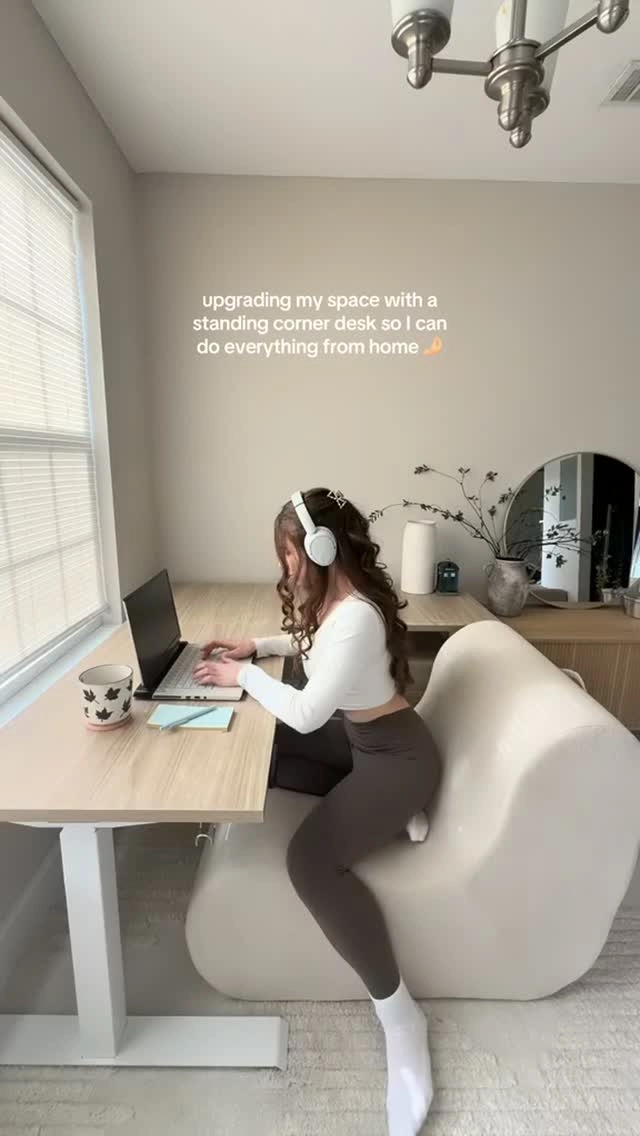
credit: @oranotrita
Ergonomics is the office's architecture and must be planned before its decoration: feet flat, elbows at desk height, screen top at eye level a full arm away, chair supporting the lower back through the longest meeting. Measure your body and your furniture with the same tape; most 'bad chairs' are good chairs at wrong heights, and most neck pain is a screen placed by hope.
The standing option (a riser, a convertible desk, a scheduled hour at the counter) enters the plan now rather than after the back files its complaint. Footrests, wrist rests, and document holders are small architecture with outsized returns. Every ergonomic piece should also pass the palette test, since it will dominate the room's photographs.
| Ergonomic Law | Measure |
|---|---|
| Feet | Flat, or on a footrest |
| Elbows | At desk height, relaxed shoulders |
| Screen | Top at eye level, arm's length |
| Chair | Lower back supported for hours |
3. Set the Palette for Focus: Calm Base, One Energizing Accent
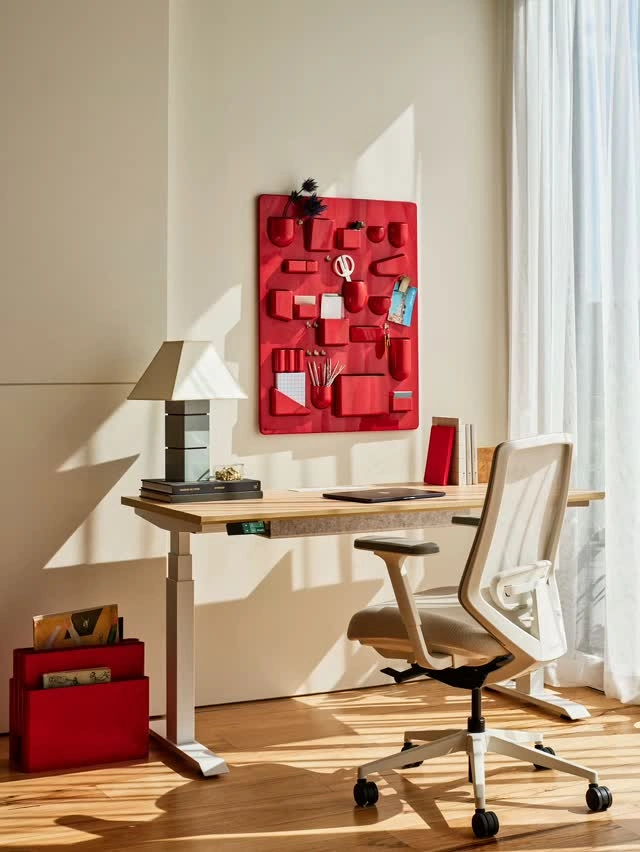
credit: @branchfurniture
Office palettes serve concentration: a calm, low-contrast base (warm neutrals, soft greens and blues, the house palette's quieter tones) that keeps the eye rested, with one energizing accent rationed to the chair, the art, or the organizer family, placed where it lifts without distracting. The backdrop's colors matter doubly, since they tint every call's impression of their owner.
Test the palette on camera before committing; screens shift colors cooler and contrasts harder. The accent should flatter skin tones at the desk's distance, since its owner is the backdrop's main exhibit. Keep the palette's discipline across every organizer and file, because small offices amplify small inconsistencies.
| Palette Layer | Office Carriers |
|---|---|
| Calm base | Walls, desk, storage |
| Support | Textiles, shelving, mat |
| Energizing accent | Chair, art, organizers |
| Camera test | Colors checked on screen first |
The Desk and Its Systems
4. Choose the Desk by Work Style: Surface, Storage, or Standing

credit: @wyrmwoodgaming
Desks divide by how their owners work: the surface worker (writer, designer) needs acreage and minimal drawers; the paper worker needs drawers and a file's reach; the multi-screen worker needs depth and cable infrastructure; the standing worker needs the convertible frame. Buy the desk your work describes, in the room's material family, sized to the territory with the chair's full travel allowed behind it.
Depth is the dimension most commonly underbought: screens at arm's length demand it. A desk against the wall serves focus; a desk facing the room serves supervision and calls; choose by the household's reality. Vintage and rescued desks pass beautifully when their heights match the ergonomic plan or accept risers gracefully.
5. Build the Cable and Power Infrastructure Once, Properly

credit: @elyse.everyday
The office's wiring is a one-time construction project: a mounted power strip with surge protection, cables trayed and labeled, the dock or hub fixed at the desk's heart, charging consolidated, and one visible cord maximum (the lamp's, dressed). Offices that wire once stop paying the daily tax of tangles, dead batteries, and photographs ruined by spaghetti.
Label cables at both ends with their device and date. Keep the floor's cable runs in channels where feet and chair wheels travel. The infrastructure photo in the office notebook saves every future troubleshooting hour from archaeology.
6. Layer Storage in Reach Rings: Daily, Weekly, Archive

credit: @cosyquirk
Office storage arranges in rings by frequency: daily tools on the desk's corral and top drawer, weekly supplies in the desk's body or the shelf at arm's turn, archives and spares in the room's closet or the house's storage. Rings keep the surface honest, since anything reaching the desk must claim daily citizenship or be demoted outward at the weekly reset.
Containers across the rings share the material family so the office reads composed from every angle. Paper's archive is a box with a date and a destruction year, not a growing glacier. The rings audit quarterly; frequency lies, and supplies migrate inward like water.
| Reach Ring | Contents |
|---|---|
| Daily | Corral, top drawer |
| Weekly | Desk body, near shelf |
| Archive | Closet, house storage |
| Audit | Quarterly, demotions enforced |
7. Light in Three Layers Tuned for Screen and Camera

credit: @lohaar134
Office light balances three audiences: the worker (task light without glare, ambient warmth), the screen (no window reflections, no bare bulbs in view), and the camera (a soft frontal source flattering the face). Layer accordingly: dimmable ambient above, an adjustable task lamp at the side, and the call light (window by day, a soft panel or lamp by night) facing the worker.
North light is the office's inheritance luck; south and west windows take sheers for glare control. Bulb temperatures agree across the layers or the camera white-balances into confusion. Evening offices lean warmer to signal the day's end to the brain that must later sleep.
8. Compose the Backdrop Like a Portrait Background
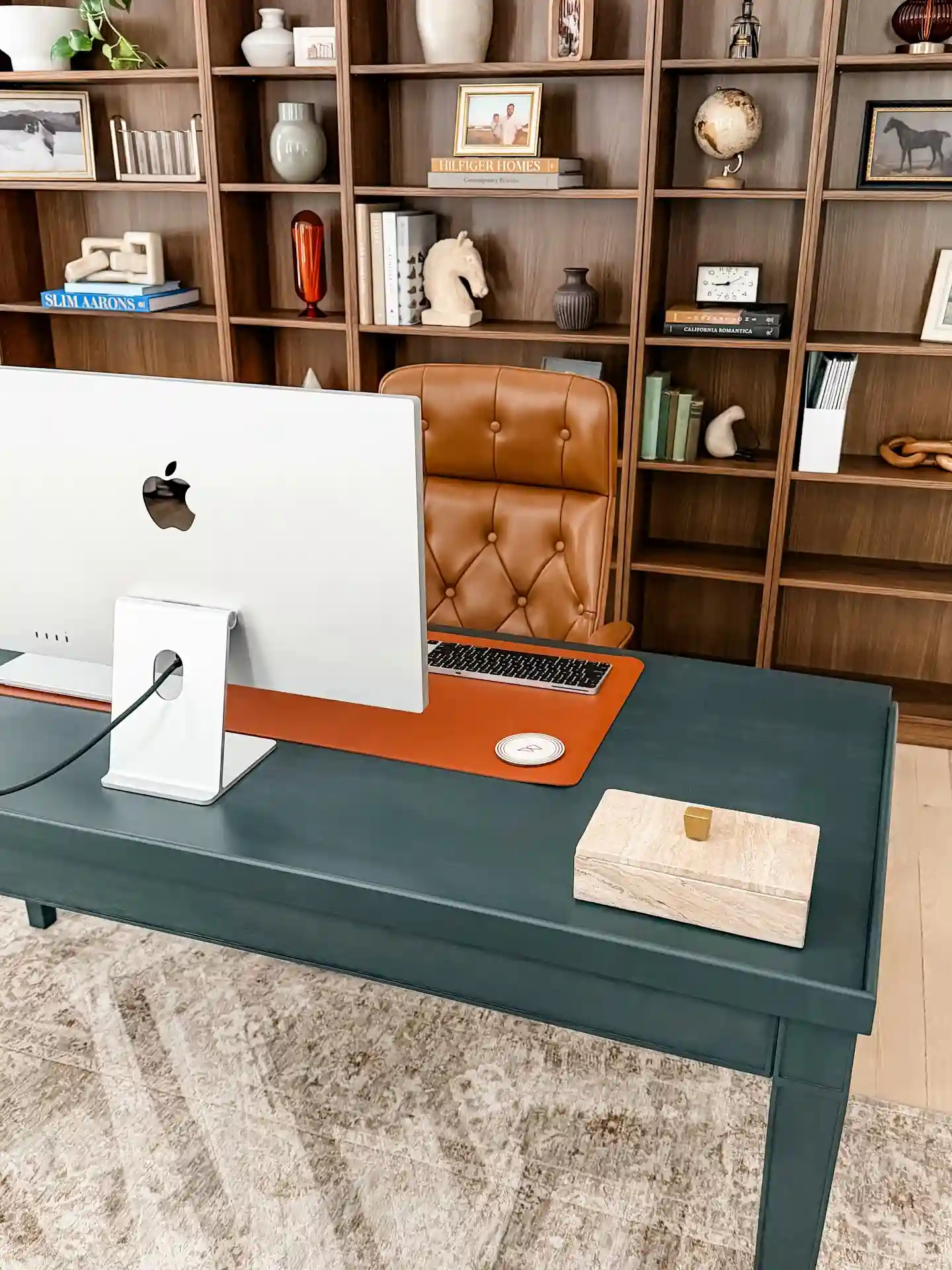
credit: @julien.lev
The wall behind the chair is the office's most public surface: compose it deliberately with a bookcase in thirds, framed pieces in the family frames, a plant for life, and the personal signature (the instrument, the collection's best shelf) rationed to one statement. Nothing distracting moves, glows, or reflects in the frame. Test the composition in the actual camera at the actual hour.
Distance matters: two to four feet between chair and backdrop gives depth without blur gimmicks. Household traffic should not cross the backdrop's territory during calls; arrange the room so the door sits outside the frame. The backdrop joins the seasonal rotation at its lightest pieces only, since colleagues notice changes and continuity reads as stability.
9. Style the Desk Surface With the Office's Own System
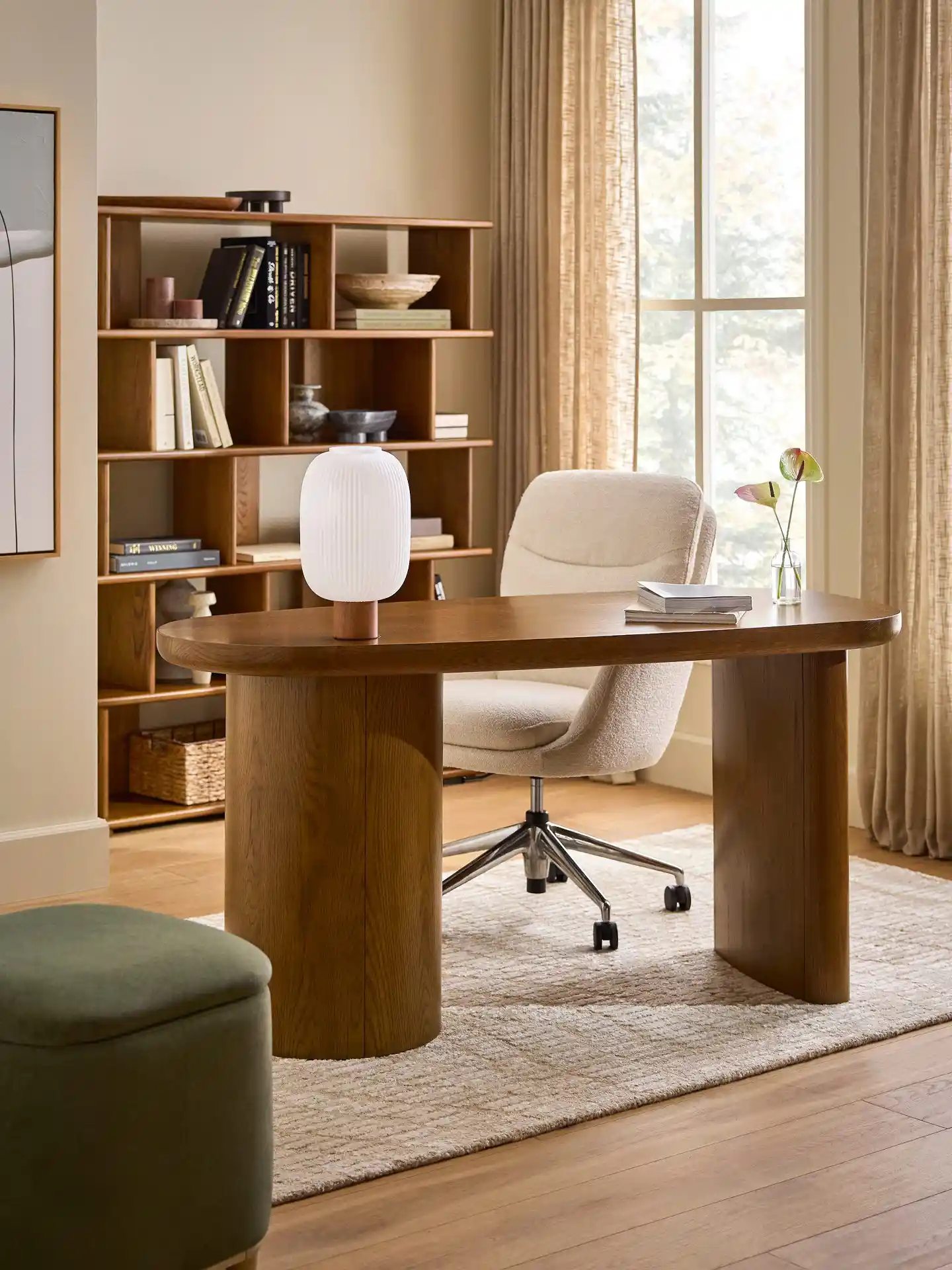
credit: @article
The office desk surface runs the desk-decor system at full discipline: zones mapped, tools corralled in the material family, paper in its three homes, the mat defining the work zone, and the back edge styled with plant, lamp, and the encouraging personal piece. An office surface styled this way photographs as competence and works as calm, in either order on any given day.
The encouraging piece at the back edge serves the worker's 4 p.m., not the camera's noon; choose for morale. Keep one surface corner deliberately empty as the landing for the day's unexpected object. The surface's portrait hangs in the office notebook as the reset's target state.
| Back Edge Ration | Piece |
|---|---|
| Living | The plant |
| Glowing | The lamp's evening post |
| Personal | The encouraging frame |
| Empty corner | Tomorrow's landing |
For a related look from a trusted source, see 40 of the best living room ideas to suit any style on Homes & Gardens.
Walls, Shelves, and Greenery
10. Build Shelving That Works: Reference, Display, and the Rotation Store

credit: @riverside.fm
Office shelves split their duties in thirds: reference within the chair's swivel (books, manuals, the current project's binders), display at the backdrop's service (vessels, framed pieces, the plant's companions), and the rotation store (supplies and seasonal pieces) in closed boxes at the extremes. Styled this way the shelving serves the worker, the camera, and the calendar simultaneously.
Book spines in the backdrop should be calm in color or turned to their page edges where the camera reads them as texture. Heavy reference goes low for the shelf's and the lifter's safety. One shelf section stays styled near-empty; office shelves breathe or they bully.
11. Hang the Working Boards: Calendar, Project Map, and the Idea Rail

credit: @itsbybecks
The office's thinking surfaces mount where eyes and hands reach from the chair: a monthly calendar or planner board, the current project's map or board, and an idea rail (a ledge, a string with clips, a small cork strip) for the fragments that arrive mid-task. Boards earn their wall by currency; a stale map is worse than a blank wall and gets wiped at the weekly reset.
Boards join the frame family so thinking looks designed. Keep the boards outside the camera's backdrop unless their content is presentable by profession. The idea rail's harvest ritual (weekly, into the notebook or the bin) prevents the rail from becoming a guilt museum.
12. Green the Office at Three Scales for Air and Eye Rest

credit: @setupcyper
Office plants work as eye medicine and air staff: a floor plant softening the room's corner, a desk plant at the back edge, and a trailing shelf plant tying the backdrop's composition. Choose species for the office's true light, group pots in the material family, and let the watering ride the Friday reset so the garden never becomes a second job's guilt.
The twenty-second eye rest (looking far, at green, hourly) is the office's smallest health ritual and the plants are its altar. Rotate a struggling plant to a kinder room without ceremony. Faux greenery serves only the backdrop's far shelf where light and honesty both run thin, one piece maximum.
| Shelf Third | Duty |
|---|---|
| Reference | Swivel reach, daily truth |
| Display | The backdrop's service |
| Rotation store | Closed boxes, extremes |
| Breathing third | Near-empty, on purpose |
13. Treat Sound: Soft Surfaces, Door Seals, and a Noise Plan
credit: @definedesignonline
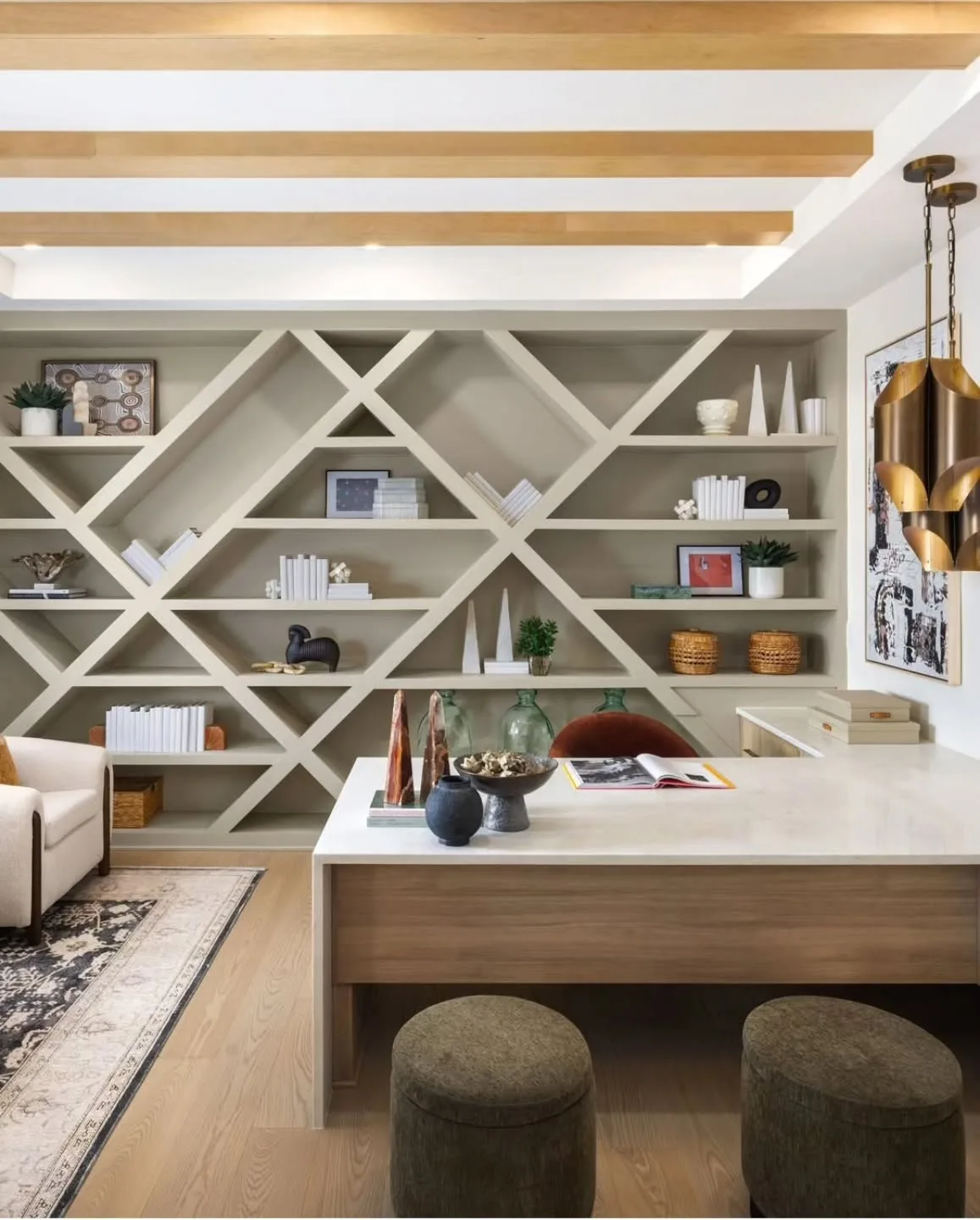
Home offices leak sound in both directions, so treat the room: a rug and textiles absorbing the office's own echo (calls sound professional in soft rooms), a door seal and draft stopper cutting the household's noise, and a noise plan for the worst hours (the call booth corner, the headphones' treaty, the household's quiet-hours calendar). Acoustic decor is invisible and its absence is audible on every recording.
The bookcase against a shared wall adds mass where it matters. Record a test call after treating; the microphone is the audit's honest ear. Household treaties (the red-light equivalent: a closed door means meetings) are sound infrastructure too, written and posted.
14. Add a Second Seat and a Thinking Corner

credit: @summerthorntondesign
Offices that host (a colleague, a client, a child with homework, the worker's own thinking) need a second seat and a corner away from the screen: a comfortable chair with a small table and its own light, where reading, calls without video, and hard problems get solved at a distance from the keyboard. The corner also gives the eyes their far focus and the day its posture change.
The thinking chair should not match the desk chair; different posture is the point. Keep the corner's table at book-and-cup scale to prevent its colonization by overflow. In small offices the corner is a cushion and a lap desk, honestly scaled.
15. Personalize at Backdrop Scale: Art, Signature, and Restraint

credit: @michellesalasb
Office personality shows at two scales: the backdrop's signature (seen by the world, chosen with intent) and the desk's private pieces (seen by the worker, chosen for morale). Keep both rations small and meaningful: one signature statement behind, three chosen pieces at the surface, photographs of the people the work supports where the worker's eyes rest at day's end.
Signatures rotate annually at most; stability on camera builds the professional legend. Private pieces rotate seasonally with the drawer store. Anything that requires explaining on a call is a distraction wearing personality's costume; retire it to the home side of the door.
| Sound Treatment | Direction It Serves |
|---|---|
| Rug and textiles | The office's own echo |
| Door seal and stopper | Household noise kept out |
| Bookcase mass | Shared-wall bleed |
| Quiet-hours treaty | The worst hours, planned |
Small Offices, Shared Offices, and Conversions
16. Convert a Closet or Alcove Into a Complete Office

credit: @crazycleaninglady222
The cloffice succeeds on ventilation, light, and vertical planning: the desk fitted to the nook's width, shelves climbing the walls, task light layered since windows are rare, a door or curtain that closes the office away at night, and air movement solved (a small fan, the door's undercut, sessions with the border open). Painted in the palette's calm base with one accent, a closet office outperforms many spare rooms because its borders are absolute.
Remove the closet's door only when the room's evenings truly forgive an open office; the curtain compromise serves most households. Electrical access decides the desk's orientation more than aesthetics do. The cloffice's chair lives outside the nook when closed, so choose one that graces the host room too.
17. Zone a Shared Room: Office by Day, Family by Night

credit: @patriciarodi
When the office shares a room (guest room, living corner, bedroom's treaty zone), zoning and ritual carry the whole design: the rug or divider drawing the border, the desk's shutdown converting it to furniture, guest or family functions stored inside closed pieces, and the palette shared so the room reads as one place with two shifts rather than two places at war.
The guest version of the room deserves a rehearsed conversion (office kit into the closet, desk styled as a dressing table) timed under ten minutes. Bedroom offices need the strictest shutdown of all, since sleep and work negotiate nightly across the same floor. The shared room's treaty is written, like all the household's border laws.
18. Run Two Workers in One Office Without War

credit: @twostates_in_love
Double offices succeed on symmetry and treaties: matched or mirrored desk zones, a shared printer and supply station on neutral ground, headphones as the constitution's first article, call schedules posted where both nations see them, and backdrops composed so neither worker's camera crosses the other's territory. Individual palettes unite under the room's calm base with each desk's accent its own.
Stagger the loudest calls by calendar diplomacy, with the thinking corner as the overflow booth. Shared supplies restock by the last-user rule, posted and honored. The double office's photograph should look like a small firm's headquarters, which is the standard its residents' careers deserve.
| Shared Rule | Form |
|---|---|
| Zones | Mirrored, accents individual |
| Neutral ground | Printer and supplies between |
| Sound | Headphones, posted call hours |
| Backdrops | No camera crosses territories |
19. Build the Standing and Movement Layer Into the Day

credit: @thebrunettebookjunkie
The decorated office should move its worker: a standing option at the desk or a counter-height annex, a walking path for calls (the room's loop, the hallway route), a stretch corner with the mat and the foam roller stored handsomely, and light that follows the worker's stations. Movement infrastructure styled into the room gets used; movement equipment stored in closets gets inherited.
Schedule movement like meetings (the calendar defends what the intentions cannot). The stretch corner's basket keeps its tools decor rather than clutter. A room that moves its worker returns them to the chair with better posture and temper, which the decor then merely has to not ruin.
Budgets, Seasons, and Career Seasons
20. Spend in Body Order: Chair, Light, Screen, Then Beauty

credit: @harrisonniap
Office budgets follow the body: the chair (eight hours of contact), the light (every hour's medium), the screen setup (the neck and the camera), the desk (the stage), and only then the ornamental layer. This order is the home office's version of the sleep-first law, and rooms bought in reverse order photograph beautifully while their residents quietly suffer through their careers.
Employer stipends, where they exist, spend on the body order first and document themselves in the notebook. Thrift and resale serve the desk and storage tiers handsomely while the chair stays bought-new for its warranty and hygiene. The ornamental layer arrives by rotation and gifting across seasons, which suits its importance exactly.
21. Rent and Borrow the Office: Portable Systems for Temporary Homes

credit: @btoiiptimist
Renters and the temporarily housed build offices from portable systems: the desk that assembles without scars, shelves that stand or lean, lighting plugged and layered, the backdrop composed on a bookcase that moves house, and acoustic softness from textiles rather than construction. The portable office improves at every address because its pieces are chosen for travel and its systems are documented in the notebook.
Photograph the landlord's room on day one and bag every original fixture you replace. Command-strip and tension solutions carry the boards and light art where screws are banned. The office's value lives in its systems and its chair, both of which board the moving truck without negotiation.
| Portable System | Travels How |
|---|---|
| Standing bookcase | The backdrop, moved whole |
| Plug-in lighting | No wiring at any address |
| Textile softness | Acoustic treatment in a bag |
| The chair | Boards first, by body order |
22. Rotate the Office Seasonally for the Brain's Freshness

credit: @urbanjungleblog
Offices stale faster than any room because their resident stares at them forty hours a week, so rotate deliberately: the backdrop's light pieces and art quarterly, the desk's personal ration seasonally, textiles by weight and tone, and one plant cast change per season. Freshness at the office is a productivity input, not a luxury, and rotations from the store cost an afternoon rather than a budget.
Keep the backdrop's signature stable through rotations; colleagues read continuity as reliability. Photograph each season's office from the door and the camera; the pair audits both audiences at once. The rotation day doubles as the deep clean and the rings audit, three chores wearing one calendar entry.
| Body Order | Buys |
|---|---|
| Chair | Eight hours of contact |
| Light | Every hour's medium |
| Screen setup | Neck and camera |
| Desk, then beauty | The stage, then the ornament |
23. Keep the Shutdown Ritual as the Office's Daily Decor

credit: @secretlab
The office's most important decor act happens at the day's end: surfaces to their portrait state, paper decided, cables and lights to their night settings, the chair tucked, tomorrow's first task staged, and the border closed (door, curtain, or the household's understanding). The ritual converts the office back into a room of the house and the worker back into a resident, nightly, which is the entire work-from-home treaty in five minutes.
The ritual's sequence is fixed and written on the office notebook's first page. Missed shutdowns tax the next morning at weekend rates of disorder. Partners and families who witness the ritual learn the border's reality better than from any announcement.
24. Plan the Office's Growth: From Corner to Room to Studio

credit: @susisfloridalife.uncut
Careers grow and offices should plan their succession: the corner's systems documented so they scale to the alcove, the alcove's to the spare room, each stage's furniture chosen to promote rather than to be replaced. The growth plan in the notebook lists the next territory, the pieces that will travel, and the upgrades queued by body order, so success never finds the office unprepared.
Buy for the next stage when the current stage's piece must be bought anyway; the chair and light already live at studio scale in this guide's order. Keep measurements of future territories (the spare room's walls, the garage's corner) in the same notebook. Growth planned this way spends once per piece across a whole career.
| Growth Stage | Systems That Promote |
|---|---|
| Corner | Zones, corral, shutdown |
| Alcove | Shelves, backdrop, rings |
| Spare room | Sound, corner, growth fund |
| Studio | The career's headquarters |
25. Dress the Office for Deep Work: Minimal Stimulus Mode

credit: @homegarden_transform
Deep work asks the office's plainest dress: the desk cleared to the current task and its tools, the boards showing only the live project, the backdrop irrelevant because the door is closed, sound treated, phone in exile, and light steady. The styled layers all remain, but arranged for invisibility, since attention is the office's true currency and decor that spends it is theft at any beauty.
The shutdown ritual has a morning twin for deep days: stage the single project, silence the rest, close the border. Decorative pieces that catch the eye mid-thought demote to the rotation store without appeal. The deep-work office photographs boring and produces brilliantly, the correct exchange rate.
Career Life at the Desk
26. Host Clients and Colleagues: The Office's Public Hours

credit: @thedesignerydenver
Offices that receive visitors (clients, colleagues, the occasional inspector of home workplaces) need a public mode: the second seat ready, the surface's public angle composed, personal and household layers behind the door or the drawer, a water glass and the guest's small comforts at hand, and the backdrop telling the professional story at full strength. Rehearse the conversion until it takes five minutes.
The guest's route through the house matters too: a clear path, a place for coats, the bathroom's location known. Client-facing offices keep one drawer entirely empty for the day's confidential layer. Hospitality at the office is a career skill wearing decor's clothes.
27. Photograph the Office Monthly: The Two-Audience Audit

credit: @studiolouinteriors
Audit the office with two photographs monthly: from the door (the resident's view) and from the camera (the world's). The pair exposes what habituation hides in each audience: the resident's creep (cables, piles, the dead plant) and the world's (backdrop drift, glare, the household life crossing the frame). Fix one confession per photograph per month and the office converges on both portraits across a year.
Shoot at the office's real working hours, since light at noon lies about the evening. Compare months in the notebook's album before buying anything; drift is cheaper to reverse than to redecorate. Invite a trusted colleague's eye to the camera shot yearly; fresh eyes catch what loyalty defends.
28. Manage Paper and Digital Clutter as One System

credit: @home_made_diyers
Office clutter is bilingual (paper piles and desktop chaos mirror each other), so manage them as one system with one weekly review: the inbox emptied into decisions, the downloads folder emptied into the archive rings, the desktop screen cleared to the current project, files named by the house convention. The physical desk's portrait and the digital desk's portrait should match in calm, since the worker lives in both.
Naming conventions are decor for the digital room: dates first, projects plain, versions honest. The weekly review rides the Friday reset beside the plants' watering. A clutter relapse in either language predicts the other within a fortnight, which makes the pair a useful early-warning system.
| Audit Shot | Audience |
|---|---|
| From the door | The resident's creep |
| From the camera | The world's drift |
| At working hours | Honest light |
| Monthly | One fix per photograph |
29. Keep a Small Comfort Station: Water, Warmth, and the Break Kit

credit: @furniturerow
The office sustains its worker with a station: water at the desk's end (the carafe or bottle that prevents kitchen drift), warmth management (the throw, the small heater or fan by season), and a break kit (the good mug, the tea or coffee ritual, the stretch band in the basket). Comfort stationed deliberately prevents the hundred small exits that fragment a workday into errands.
Keep food's empire out of the office beyond the break kit; desks that dine become dining rooms with laptops. The station restocks at the weekly reset. A worker who must leave the room only for meetings and movement has a room that finally serves the work.
30. Adapt the Office for Creative, Technical, and Care Work

credit: @getquickstudio
Different work dresses the same bones differently: creative work adds the project zone and the inspiration rail at full size; technical work deepens the cable infrastructure and the reference rings; care and counsel work softens everything (the second seat closer, tissues and water within the guest's reach, the backdrop at its most reassuring). The foundations (ergonomics, light, borders) hold across professions; the dress declares the trade.
Let the adaptation show in one or two deliberate signals rather than in themed excess. Professions with confidentiality duties add the lockable drawer and the screen's privacy angle to the foundations. The office that declares its trade calmly earns trust before its owner speaks.
| Trade | Dress Signal |
|---|---|
| Creative | Project zone, idea rail full-size |
| Technical | Deep cables, reference rings |
| Care work | Second seat close, soft backdrop |
| All | Foundations unchanged |
31. Solve the Home Office's Three Pains: Loneliness, Drift, and Never Leaving

credit: @elpierceo
The home office's classic pains are emotional, not spatial: loneliness (answered by the plant cast, the photograph at eye rest, the thinking corner's comfort, and the calendar's deliberate people), drift (the room slowly becoming storage, answered by the audits and the border), and never leaving (answered by the shutdown ritual, the movement layer, and light that changes shift). Decor that ignores these pains is styling a problem; decor that treats them is occupational health.
Name the pains in the notebook's audit page so their treatments get reviewed like any system. The office's kindest feature may be its window or its door; protect whichever yours is. Workers who treat the pains keep their offices, and their affection for them, for entire careers.
| Pain | Decor's Treatment |
|---|---|
| Loneliness | Plants, photographs, people by calendar |
| Drift | Audits, borders, the rings |
| Never leaving | Shutdown, movement, shifting light |
| All three | Systems, not shopping |
32. Let the Office Earn Its Room Every Quarter
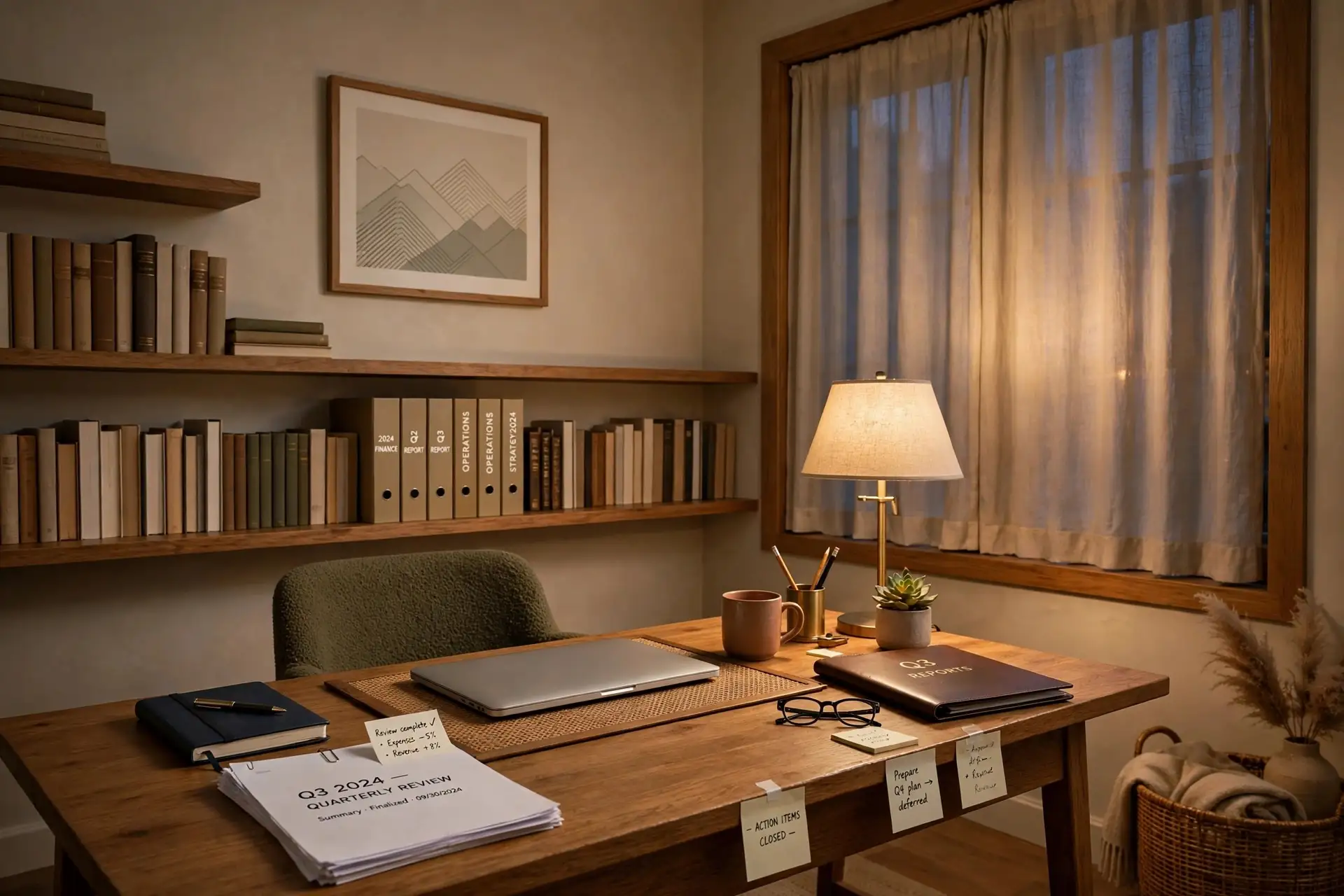
The finished home office justifies its territory on a quarterly review: output it enabled, health it protected, impressions it made on camera, and evenings it surrendered back to the house. Offices that pass stay and grow by the plan; offices that fail get redesigned from the foundations rather than redecorated at the surface. The room is a tool of the career, and this guide's whole argument is that tools deserve beauty exactly in proportion to their use.
Write the review beside the growth plan in the notebook, dated, with the next quarter's one improvement chosen from the evidence. Celebrate the office's wins in the review; rooms respond to regard like gardens do. A career's longest room deserves its quarterly hour of honest attention.
| Quarterly Review | Evidence |
|---|---|
| Output enabled | Projects shipped from this desk |
| Health protected | Pain log, posture honest |
| Camera impressions | Calls and recordings reviewed |
| Evenings surrendered | Shutdowns completed |
Common Mistakes With Home Office Decor
Home offices fail by reversing the order: ornament before ergonomics, backdrop before light, and styling where a shutdown ritual was needed.
| Mistake | Why It Fails | Do This Instead |
|---|---|---|
| Decorating before chair, light, and screen | A beautiful room that injures its worker | Body order: chair, light, screen, beauty |
| Ignoring the backdrop until a call | The world meets your laundry | Compose it like a portrait, test on camera |
| No border or shutdown ritual | Work colonizes the home and the night | A defensible line, closed nightly |
| Storage without reach rings | Supplies migrate onto the desk | Daily, weekly, archive, audited quarterly |
| One bright overhead light | Screens glare, faces flatten, eyes tire | Three layers tuned for screen and camera |
Home Office Decor by Situation: 4 Ready-Made Plans
If You Have a Spare Room and a Real Budget
Build the full system in body order: the chair and desk fitted to your measures, the infrastructure wired once, shelving in thirds, backdrop composed and camera-tested, sound treated, the thinking corner furnished, and the ornamental layer arriving by rotation. Write the growth plan and the quarterly review into the notebook from the first month. This office is a career asset; treat its budget as one.
If Your Office Is a Corner of Another Room
Zone and ritual carry everything: the rug and divider drawing the border, the desk's systems compressed (corral, mat, trayed cables), the backdrop composed on a bookcase that doubles as the divider, and the shutdown converting the corner back to the host room nightly. Bedroom corners take the strictest shutdown; living corners take the most camera care.
If You Work Hybrid and Share the Desk
Run the hot-desk discipline at home: each worker's kit in a docking caddy, the surface's portrait state restored at every handover, the backdrop neutral-professional for both, and the calendar governing the territory's shifts. Storage rings split by worker with a shared weekly shelf. The handover ritual is the whole design; everything else is furniture.
If You Are Converting a Closet
Ventilation and light first, then vertical everything: fitted desk, shelves climbing, layered task light, the chair that graces the host room when the border closes, and the palette at its calmest since the walls are close. Keep sessions' air moving and the curtain ready. A well-run cloffice outperforms spare rooms whose borders leak.
You will also find plenty of inspiration in Home Office Layout Ideas: 13 Ways to Invent Workspace at Apartment Therapy.
Frequently Asked Questions About Home Office Decor
Where should I start with home office decor?
With the border and the body: choose a defensible territory (a door if possible), then plan ergonomics as architecture (chair, desk height, screen line), wire the cable infrastructure once, and set the calm palette. Ornament arrives last, by rotation. Rooms started at the foundations stay offices; rooms started at the cushions become storage with a desk in it.
What is the most important piece of home office furniture?
The chair, by hours of contact and by consequence: it holds your posture for your whole career's working days. Buy it new, fitted, and in the palette, before any ornamental spending. The lamp is second (every hour's medium) and the screen setup third (the neck and the camera both live there).
How do I make a home office look professional on video calls?
Compose the backdrop like a portrait background: a bookcase in thirds, framed pieces, one plant, one signature statement, nothing moving or reflective, two to four feet behind the chair, tested in the actual camera at the working hour. Add a soft frontal light for the face. Household traffic must not cross the frame; arrange the door outside it.
How can I fit a home office in a small apartment?
Take the smallest defensible territory (a closet, alcove, or zoned corner), fit the desk to the nook, climb the walls with shelves, layer light since windows are rare, and enforce the shutdown ritual so the office vanishes into the host room nightly. Borders matter more than square footage; a curtained cloffice outperforms a sprawling spare-room desk whose work leaks everywhere.
What colors are best for a home office?
A calm, low-contrast base (warm neutrals, soft greens or blues) that rests the eye, with one energizing accent rationed to the chair, art, or organizers. Test the palette on camera first, since screens cool colors and harden contrast. The backdrop's tones should flatter the resident's skin at desk distance, because the resident is its main exhibit.
How do I keep a home office tidy?
Storage in reach rings (daily on the desk, weekly at the shelf, archive in the closet), paper and digital clutter reviewed as one system weekly, and a five-minute shutdown ritual nightly restoring the surface to its portrait with tomorrow staged. Audit monthly with two photographs (door view and camera view) and fix one confession each.
Should a home office have a door?
Ideally yes: a closing door is the office's most valuable feature, outranking space, for sound, borders, and the shutdown's finality. Where no door exists, substitute in order: a bookcase divider, a screen, a curtain, and a household treaty posted and honored. The border must be physical enough for a child to read at a glance.
How much should I budget for a home office?
Spend in body order and let that set the total: a proper chair, layered light, and a correct screen setup form the non-negotiable core (bought well, once), the desk and storage can be rescued or mid-range, and ornament is rotation money. Employer stipends spend on the core first. A sequenced office bought across two quarters beats a spree every time.
Can a home office double as a guest room?
Yes, with zoning and a rehearsed ten-minute conversion: the desk shuts down into furniture, the office kit stores in the closet, the bed dresses from the guest kit, and the palette stays shared so the room reads as one place with two shifts. The office's border becomes the guest's privacy line, which both shifts respect.
Conclusion: The Room That Works as Hard as You Do
Home office decor succeeds in its order: a border defended, the body fitted like architecture, light tuned for screen and camera, storage ringed by frequency, the backdrop composed like a portrait, and a shutdown ritual returning the room and its worker to the house each night. Beauty rides on those systems and lasts exactly as long as they do. Start with the territory and the chair this week, and let the styling earn its turn.
*Ready to build a room that works? Start with tip 1 and choose the territory.*
—



One Comment