Outdoor Patio Ideas: 32 Proven Ways to Build an Outdoor Room
Your outdoor patio ideas succeed or fail on zones, not furniture. This guide gives you 32 exact steps, each with a measurement, a material, and a result you check with your own eyes. As professional exterior designers consistently find, patios that get used daily split into clear seating, dining, and green zones with one palette running through all three. Work the sections in order and your outdoor patio ideas build from bare slab to a finished outdoor room.
One number guides every purchase in this guide. Your full scheme lands between $180 and $350, excluding major furniture you already own, and every tip below states its cost before you buy.
Before You Begin: Five Foundation Steps for Outdoor Patio Ideas
Bare slabs collect random chairs within one season. This foundation section fixes your zones, your sun map, and your budget before a single purchase. Every later section builds on these five steps and spends inside the limits set here.
1. Measure the Patio and Divide It Into Three Zones
credit: @amazonhome
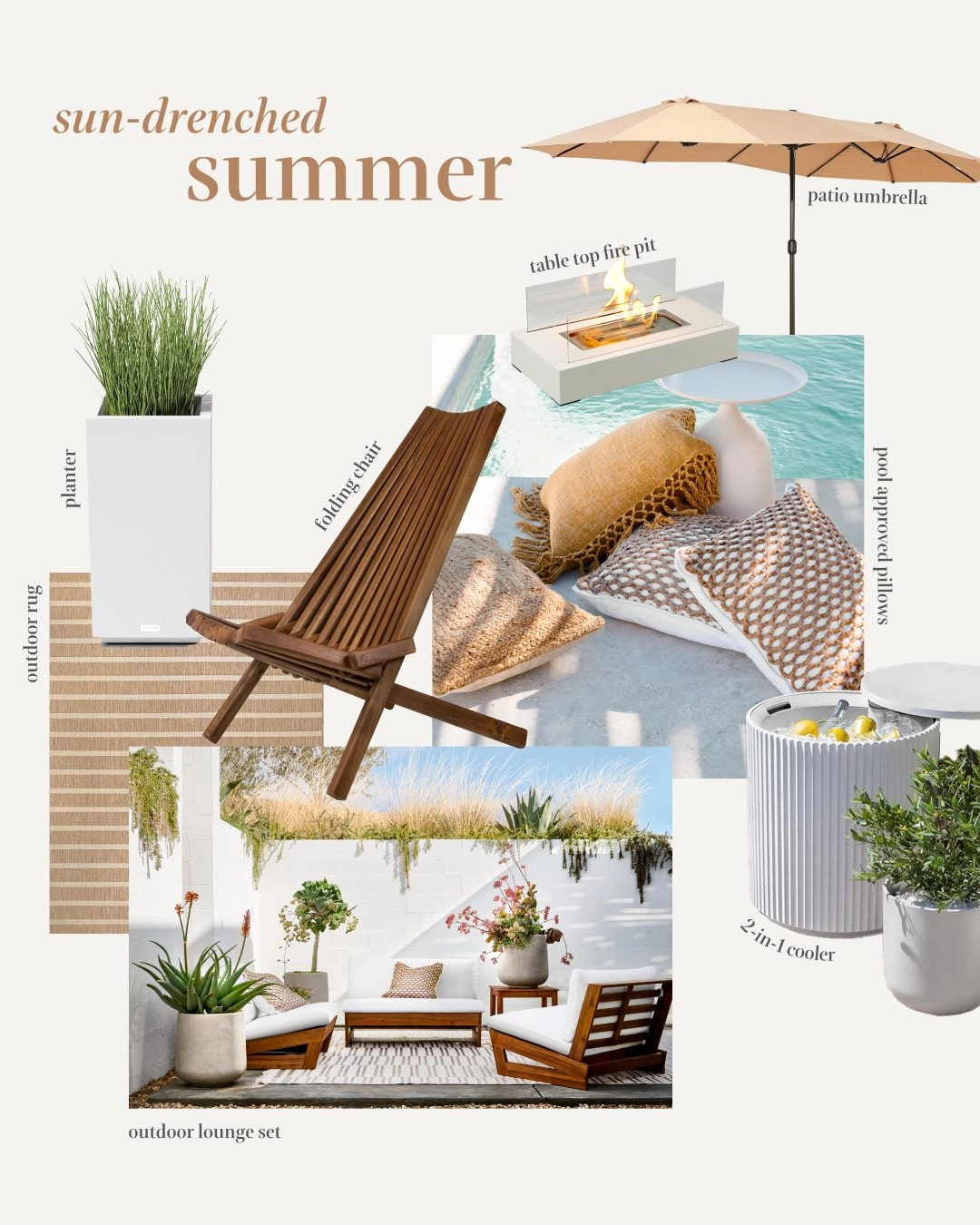
Random layouts waste the slab’s best corners. Three zones give every activity its own ground. Seating takes the shaded third, dining the level third, and greenery the edges.
Measure the slab’s length and width and sketch both on paper. Mark a seating zone, a dining zone, and a green edge with chalk lines. Keep one 36-inch path clear from the door to the yard across all three zones.
2. Map Sun and Shade at 10 a.m., 1 p.m., and 5 p.m.

credit: @terranearesort
Furniture placed by morning shade bakes by afternoon. A three-point sun map puts seats where shade actually lands at sitting hours. One day of watching saves a season of moving chairs.
Stand on the patio at 10 a.m., 1 p.m., and 5 p.m. and sketch the shade line each time. Place the main seats inside the 5 p.m. shade zone. Note the hottest corner; it gets heat-loving pots, never cushions.
3. Lock a 60-30-10 Palette of Cream, Terracotta, and Black

credit: @fergusonhomeofficial
Random outdoor colors fight the house and garden at once. One locked palette makes every later purchase automatic. Cream carries textiles, terracotta leads pots and accents, and black frames the metal.
Assign 60 percent of visible surfaces to cream, 30 percent to terracotta, and 10 percent to black metal. Write the three names on one card and carry it on every shopping trip. Any piece outside the three names stays on the shelf, no matter the discount.
4. Set a $350 Total Budget and Split It in Four

credit: @jdwilliamsuk
Patio displays grow one small purchase at a time until the total shocks you. A split budget stops the creep at the first store. Each category below gets a hard ceiling.
Divide $350 into $120 for seating textiles and shade, $90 for lighting, $80 for planters and plants, and $60 for dining and details. Track every receipt against its column the same day. A column that hits its ceiling closes until something returns to the store.
| Category | Ceiling | Main Buys |
|---|---|---|
| Seating + shade | $120 | Cushions, umbrella, throw |
| Lighting | $90 | String lights, lanterns |
| Planters + plants | $80 | Pots, soil, plants |
| Dining + details | $60 | Tableware, tray, rug |
5. Sweep, Wash, and Check the Slab for Level Spots

credit: @marykayandrews
Decor over a dirty, rocking slab fails at the first dinner. One wash shows cracks, stains, and the true level areas. Dining goes only on ground where a glass stands steady.
Sweep the slab, then scrub it with water and a stiff brush. Watch where water pools; those spots mark the low ground. Set the dining table only where a filled glass sits without rocking on all four legs.
Outdoor Patio Seating and Layout Foundations
Seating decides whether a patio hosts or stores. This section sets the rug anchor, seat counts, conversation distances, and side surfaces. Every measurement assumes the 36-inch path from Tip 1 stays clear.
6. Anchor the Seating Zone With a 5-by-7-Foot Outdoor Rug

credit: @chairishco
Chairs on bare concrete drift apart all season. A rug locks the seating group into one island. Outdoor weave dries fast and shrugs off spills.
Lay a 5-by-7-foot outdoor rug in the seating zone, centered on the 5 p.m. shade from Tip 2. Set every chair’s front legs on the rug by at least 6 inches. Leave 12 inches of slab showing between the rug edge and the dining zone.
| Rug Size | Seats Anchored | Slab Edge Show |
|---|---|---|
| 5 x 7 ft | 2-4 | 12 inches |
| 8 x 10 ft | 4-6 | 12 inches |
| 4 x 6 ft | 2 (small patio) | 8 inches |
7. Face Seats Toward Each Other at 6 to 8 Feet Apart
credit: @roomandboard
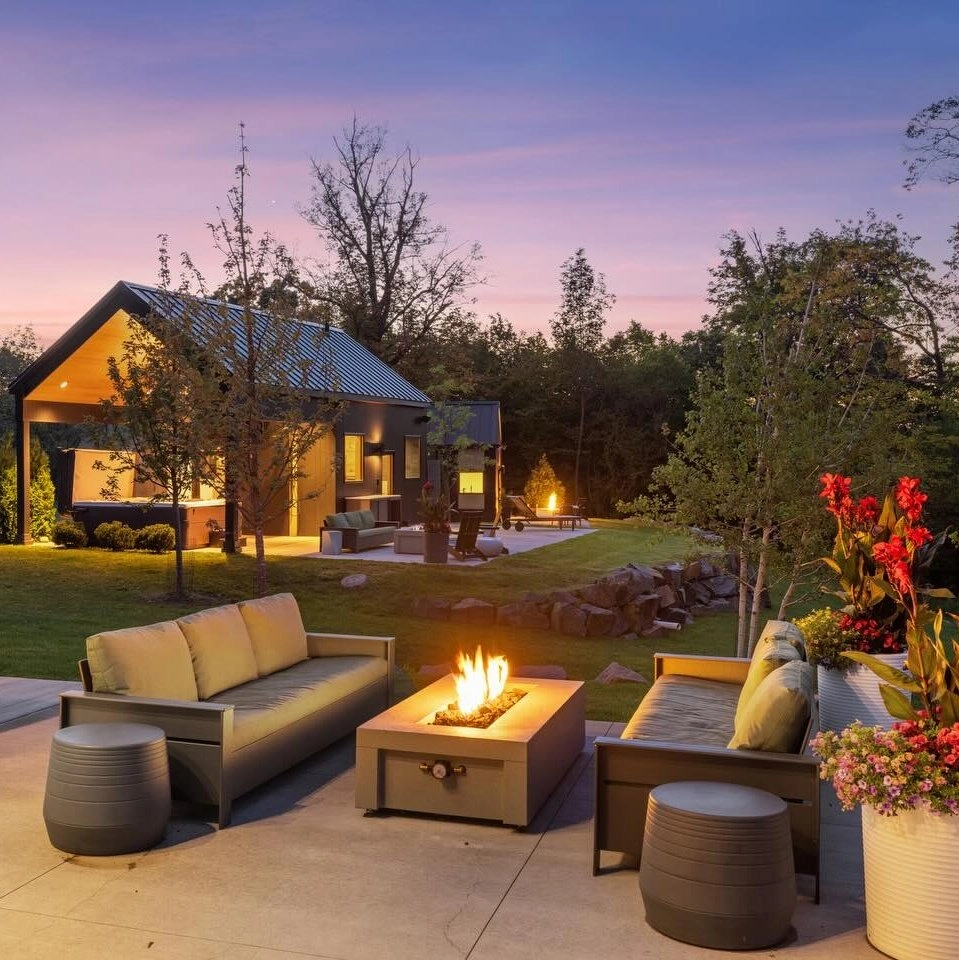
Chairs lined against a wall kill conversation. Face-to-face spacing at talking distance makes the zone social. Beyond 8 feet, voices rise and guests drift indoors.
Place the main seats facing each other, 6 to 8 feet apart edge to edge. Angle side chairs at 45 degrees toward the group’s center. Keep the whole group inside the rug’s borders from Tip 6.
8. Set One Side Table Within Arm’s Reach of Every Seat

credit: @ballarddesigns
Drinks on the ground spill at the first footstep. One reachable surface per seat keeps glasses safe and guests seated. Heights match the chair arms for easy setting down.
Set one 18-inch side table beside every seat, its top level with the chair arm. Keep each table inside the seating zone, clear of the 36-inch path. A table per two seats is the minimum for a loveseat pair.
| Seats | Side Tables | Top Height |
|---|---|---|
| 2 chairs | 2 | Level with arms |
| Loveseat + chair | 2 | Level with arms |
| 4 chairs | 3-4 | Level with arms |
9. Layer Outdoor Cushions in Cream With Terracotta Piping

credit: @ngood.co
Bare frames read cold and sit worse. Cushions carry the palette onto every seat and invite long evenings. Outdoor fabric with piping holds shape through the season.
Fit seat and back cushions at 4 inches thick in cream outdoor fabric. Choose terracotta piping so every seat carries both lead colors. Store cushions under cover on rain nights; the habit in Tip 29 sets the routine.
10. Add One Outdoor Throw Per Two Seats for Cool Evenings
credit: @provincialhomeliving
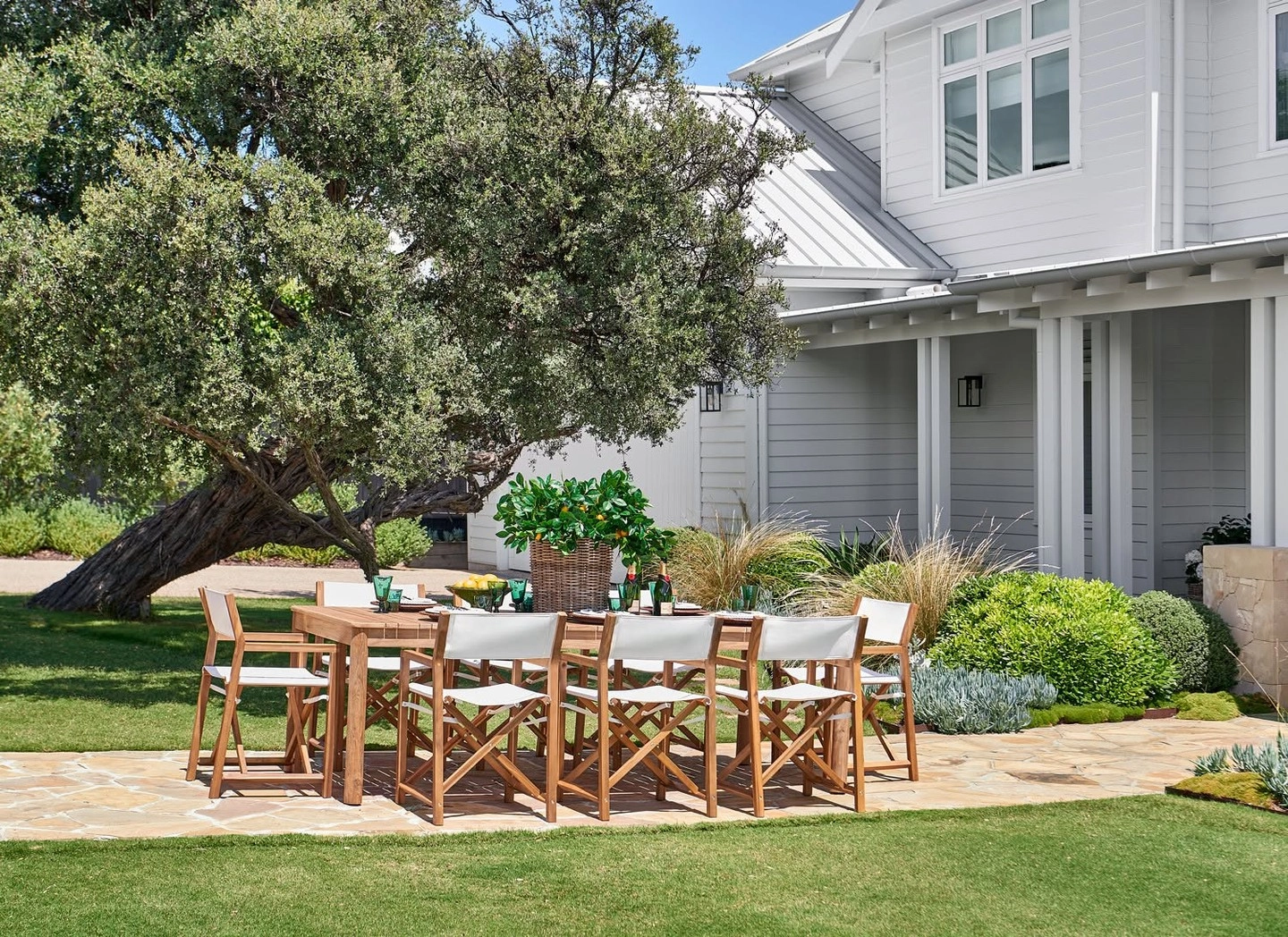
Evenings end early when guests get cold. A throw per two seats stretches patio hours by weeks on both ends of the season. The throws repeat the indoor palette at the door line.
Drape one 50-by-60-inch outdoor throw over each loveseat arm or chair back. Wash throws monthly per Tip 31 and store them in the deck box overnight. Two throws cover four seats at about $16 each.
| Seats | Throws | Storage |
|---|---|---|
| 2 | 1 | Deck box |
| 4 | 2 | Deck box |
| 6 | 3 | Deck box |
Outdoor Patio Shade, Light, and Privacy
Shade makes the patio usable, light makes it magical, and privacy makes it relaxing. This section builds all three layers with exact heights and spacings. Every number repeats the indoor system’s 2700K standard.
11. Set a 9-Foot Umbrella Tilted Toward the 5 p.m. Sun

credit: @remaxcanada
Vertical umbrellas shade the table at noon and nothing at dinner. A tilt toward the low sun covers seats at the hour they fill. The 9-foot canopy covers a four-seat group fully.
Set a 9-foot umbrella in a base of at least 50 pounds. Tilt the canopy 30 degrees toward the 5 p.m. sun position from your Tip 2 map. Close it whenever winds pass 15 miles per hour or rain turns heavy.
12. String Lights in Swags at 8 Feet With a 12-Inch Drop

credit: @nigellalawson
String lights turn a slab into a room after dark. Even swags at standing clearance give the glow without ducking. Warm 2700K bulbs match the indoor light through the glass doors.
Hang commercial-grade string lights at 8 feet, clearing the tallest guest by 12 inches. Let each swag drop 12 inches between anchor points spaced 8 feet apart. Use one guide wire per run so bulbs never carry the line’s weight.
| Run Length | Anchors | Swag Drop |
|---|---|---|
| 16 feet | Every 8 feet | 12 inches |
| 24 feet | Every 8 feet | 12 inches |
| 12 feet | Every 6 feet | 10 inches |
13. Set Three Lanterns at Floor Level Around the Seating Zone
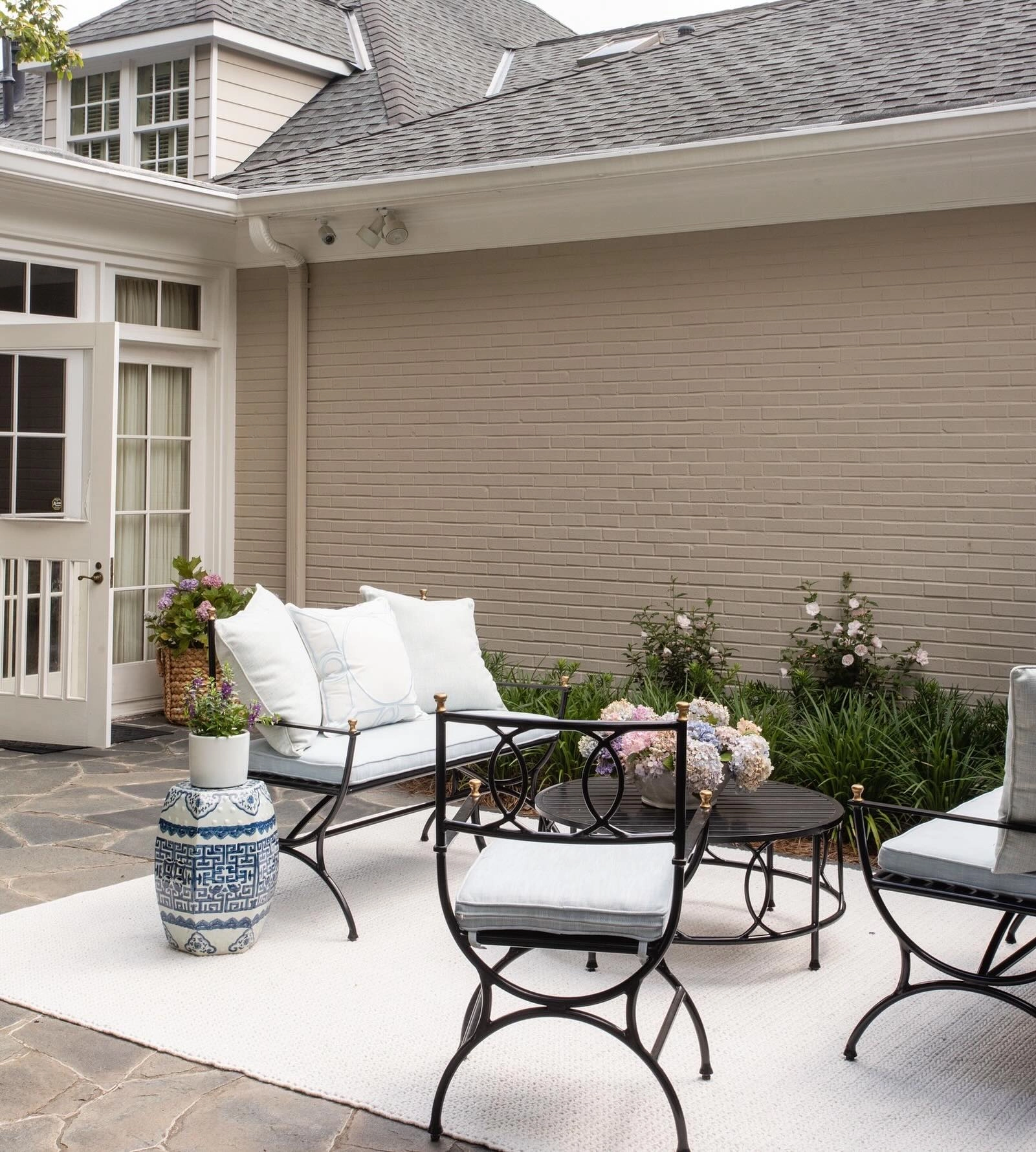
credit: @annieselke
Overhead light alone flattens the patio’s edges. Floor lanterns pool warm light at ankle height and mark the zone’s border. Three points form the triangle every guest reads as the room.
Set one 16-inch black lantern at each corner of the seating triangle. Fit amber flameless pillars on the same 6 p.m. timer as the house lights. Keep each lantern 6 inches inside the rug or slab edge, clear of feet.
14. Hang a Shade Sail Corner at 9 Feet for the Dining Zone
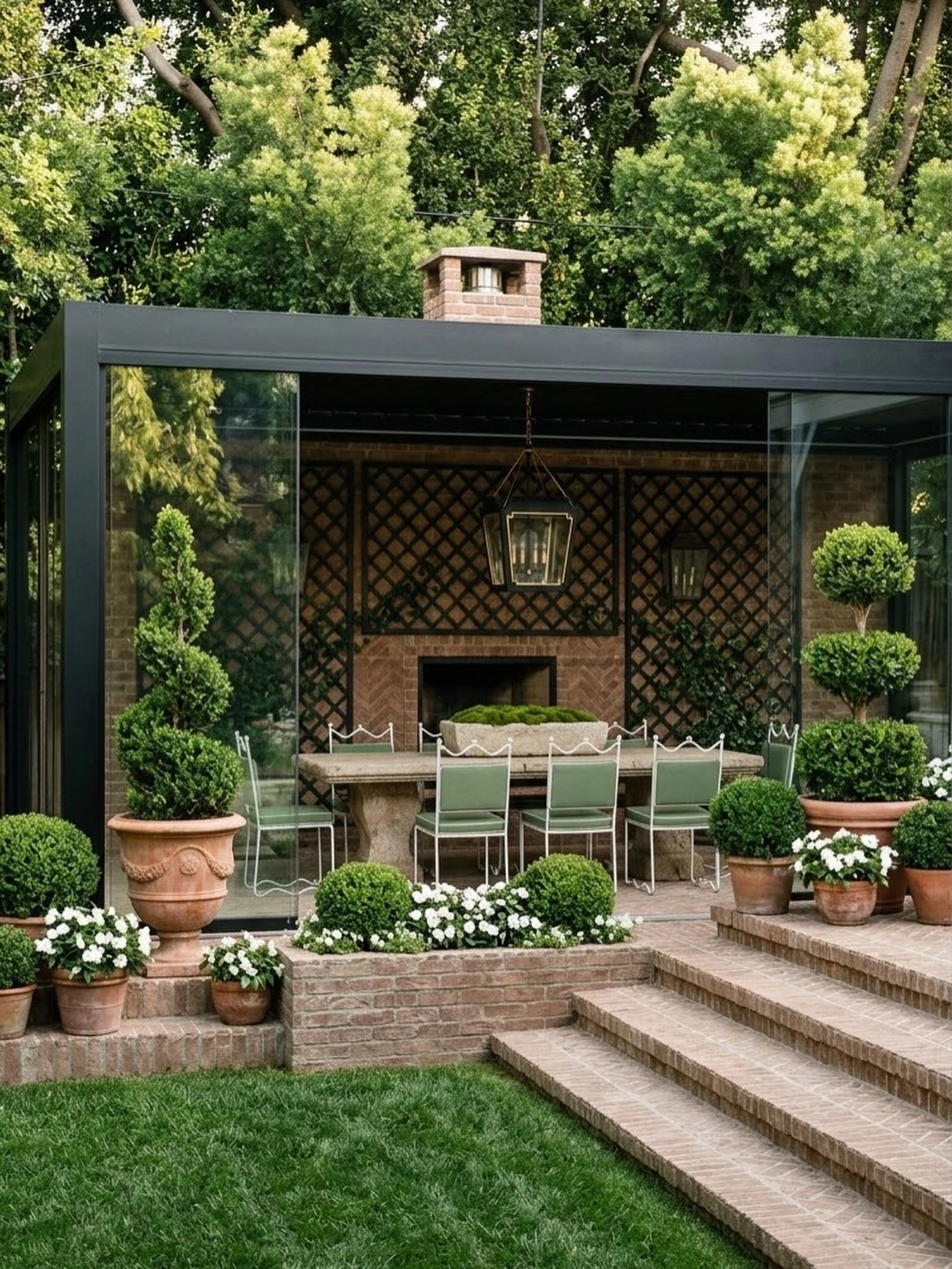
credit: @ryansaghian
Dining under direct sun ends meals early. A shade sail cools the table zone by up to 15 degrees. One high corner and two low corners shed rain off the fabric.
Mount a triangular sail with its high corner at 9 feet and low corners at 7.5 feet. Tension every corner until the fabric holds no wrinkles. The slope sheds rain to the low side, away from the table.
15. Grow a Privacy Screen of Planters Along the Open Edge

credit: @roseuniacke
Open patio edges face neighbors, streets, and wind. A planter screen blocks sightlines at sitting height without a fence permit. The green layer also cools the edge zone.
Line the open edge with planters at 24-inch centers, each at least 20 inches tall. Fill them with ornamental grasses or bamboo reaching 4 to 5 feet. The screen blocks seated sightlines while air still moves through the leaves.
Outdoor Patio Planters, Dining, and Entertaining
Greenery softens concrete and metal into a garden room, and the dining zone earns the patio its evenings. This section sets planter groups, herb pots, a vertical garden, and the watering system, then the table, serving flow, drink station, and fire feature. Groups follow the odd-number rule from the indoor guides.
16. Group Planters in Threes at Three Heights

credit: @sharmas.india
Single pots scattered along edges read as storage. Groups of three at staggered heights read as design. One group per zone ties the whole slab together.
Set planters at 12, 16, and 20 inches together at each zone corner. Fill the tallest with a structural plant, the middle with flowers, the smallest with a trailer. Repeat the same three heights at every corner for rhythm.
| Pot | Height | Plant Job |
|---|---|---|
| Tall | 20 inches | Structure |
| Middle | 16 inches | Flowers |
| Small | 12 inches | Trailer |
17. Plant a Herb Trio in the Sunniest Corner

credit: @kierking8
Herbs earn their patio space at every meal. The sunniest corner, useless for cushions, grows basil, rosemary, and mint best. Snipping distance from the dining table keeps them used.
Set three 10-inch terracotta pots in the hottest corner from Tip 2. Plant basil, rosemary, and mint, the mint always in its own pot. Keep the trio within 6 feet of the dining table for mid-meal snipping.
18. Hang a Vertical Planter Panel on the Blank Wall
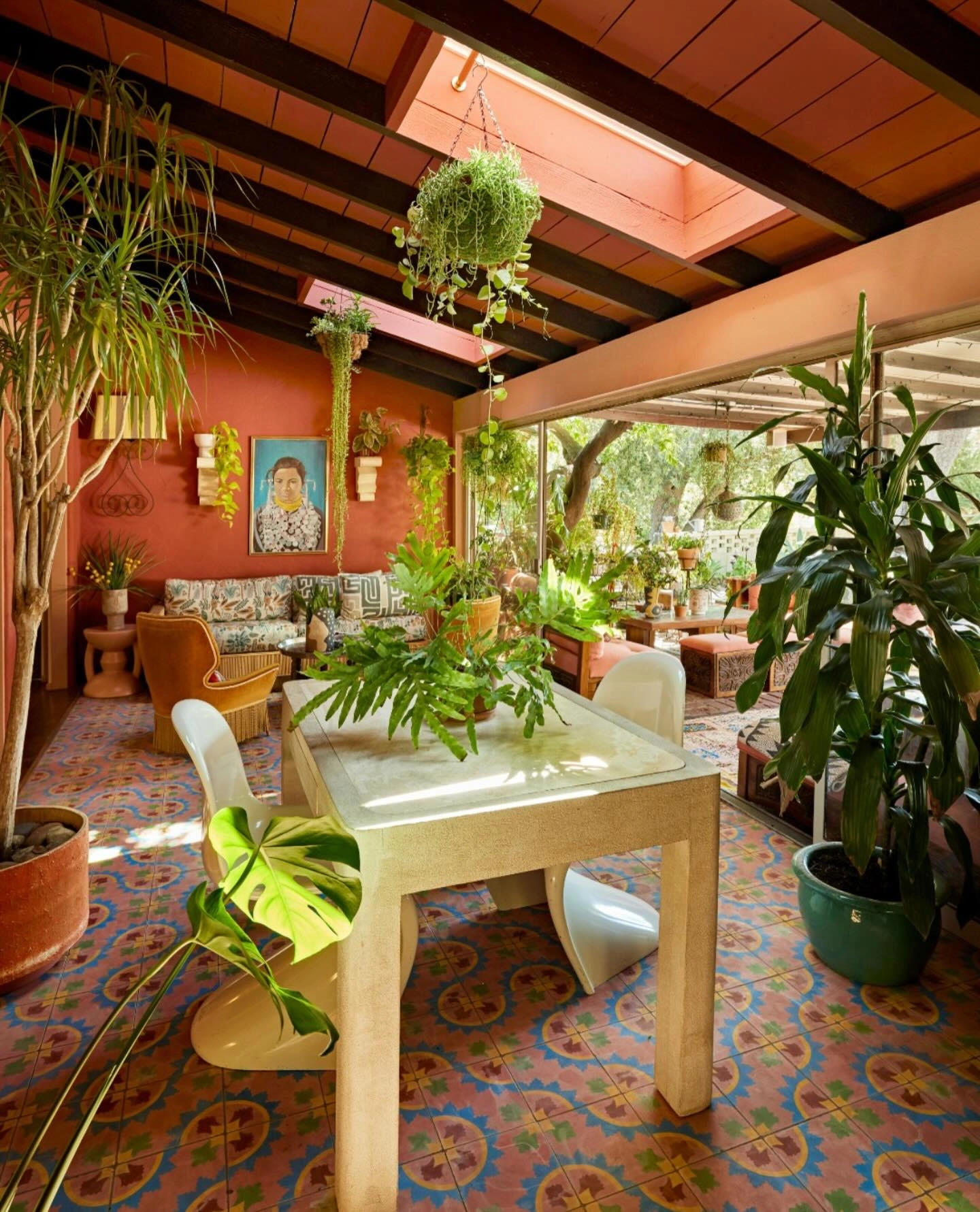
credit: @thejungalow
Blank patio walls waste the garden’s best growing plane. A vertical panel turns it into a green backdrop for the seating zone. Twelve pockets hold a full herb or flower wall.
Mount a 12-pocket vertical planter at 48 to 66 inches on the blank wall, screwed into studs or masonry anchors. Fill top pockets with trailers and bottom pockets with upright herbs. Water from the top pocket down; the panel drains in sequence.
19. Set One Statement Tree Pot at the Seating Zone’s Corner

credit: @homecentrestores
Small pots alone never give a patio presence. One large tree pot anchors the main corner at eye level. Olive, fig, and citrus all thrive in pots at this size.
Set one 24-inch pot at the seating zone’s outer corner. Plant a 4-foot olive, fig, or citrus and underplant its base with trailing thyme. The tree’s canopy starts the shade the umbrella finishes.
20. Run a Drip Line to Every Planter Group on One Timer

credit: @kateen_la
Hand watering twenty pots fails by week three. One drip line on a timer waters every group evenly. The system pays for itself in saved plants within one season.
Run a half-inch drip line along every planter row from one faucet timer. Fit two 1-gallon-per-hour emitters per large pot and one per small pot. Set the timer for 6 a.m., 30 minutes daily, and adjust by season per Tip 30.
21. Set a Dining Table for 24 Inches Per Guest Outdoors Too

credit: @tastedesigninc
Crowded settings spill drinks on concrete all night. The indoor 24-inch rule works outdoors unchanged. Measure the table before buying a single chair.
Allow 24 inches of table width per guest and keep centerpieces under 12 inches tall. A 72-inch table seats six with true elbow room. Chairs pull out 24 inches behind each setting, inside the dining zone’s borders.
| Table Length | Guests | Chair Pull-Out |
|---|---|---|
| 48 inches | 4 | 24 inches |
| 72 inches | 6 | 24 inches |
| 96 inches | 8 | 24 inches |
22. Station Drinks on a Bar Cart Outside the Walkway

credit: @kare_design
Drink traffic through dining chairs causes the evening’s spills. A bar cart pulls that flow outside the seating zone. The cart also rolls indoors when weather turns.
Park a two-tier bar cart at the dining zone’s edge, 36 inches clear of chair backs. Load the top tier with a dispenser and glasses, the bottom with bottles and a towel. One cart serves the whole patio without a single trip indoors.
23. Add a Fire Pit at 36 Inches Clear of Every Seat

credit: @lovely.harbor
Fire extends patio season further than any other single piece. A measured safety ring makes it welcome instead of worrying. The pit doubles as the evening’s gathering center.
Set a fire pit on the slab’s stone or gravel area, 36 inches clear of every seat edge and 10 feet from the house wall. Keep a spark screen on whenever the fire burns. Store a 5-pound extinguisher within reach of the main seat.
| Fire Piece | Clearance | Fuel |
|---|---|---|
| Bowl pit | 36 in from seats | Wood, with screen |
| Tabletop pit | 24 in from settings | Gel or propane |
| Chiminea | 36 in + wall gap | Wood |
24. Lay an Outdoor Runner Under the Dining Table

credit: @carrierandco
Bare concrete under dining chairs scrapes and echoes. An outdoor runner softens sound and defines the dining zone. Flat weave lets chairs slide without catching.
Lay a flat-weave runner 24 inches wider than the table on every side. Chairs stay on the rug even pulled out for seating. Hose it down monthly; outdoor weave dries within hours.
25. Mount One Weatherproof Speaker at 7 Feet in the Corner

credit: @melaniebenjamin_author
Music from a phone on the table dies under conversation. One mounted speaker fills the patio evenly at low volume. Corner placement bounces sound across both zones.
Mount one weatherproof speaker at 7 feet in the corner between the seating and dining zones. Angle it down 15 degrees toward the rug. Keep volume at conversation level; neighbors set the true limit.
| Speaker | Mount Height | Angle |
|---|---|---|
| Corner unit | 7 feet | 15 degrees down |
| Pair | 7 feet | 15 degrees down |
| Portable | Table level | Away from seats |
Outdoor Patio Styling and Finishing Touches
Zones and layers are in place. This short section handles the final pass: balance, the dusk test, and the photograph that locks the scheme for next season. Small moves here separate styled patios from furnished ones.
26. Repeat Every Palette Color at Least Three Times per Zone

credit: @arielokin
A single terracotta pot reads as an accident. Three sightings per zone read as a scheme. This audit pass counts every color in each zone.
Stand at the door and count each color’s sightings per zone. Terracotta must appear at least three times in every zone, cream as the base everywhere. Add one small piece, a pot or napkin set, wherever a count falls short.
27. Test the Patio at Dusk From the Main Seat

credit: @wayfairprofessional
Daylight hides dark corners and glare spots. The dusk test from the main seat shows the patio as guests see it. Every fix below takes under two minutes.
Sit in the main seat at dusk with house lights off. Mark every dark corner bigger than a chair and every bulb glaring at eye level. Move one lantern into each dark corner and angle glare bulbs away from seats.
28. Photograph the Finished Patio at Golden Hour

credit: @serenaandlily
Memory flattens a scheme by next spring. Golden-hour photos preserve every placement at its best. The set becomes next season’s setup guide.
Stand at the yard’s edge at golden hour and take four photos: wide, seating, dining, and green edge. Save them in one album named with the year. Note any zone that photographed flat and plan its upgrade first next season.
| Photo | Angle | Captures |
|---|---|---|
| 1 | Wide from yard | Whole scheme |
| 2 | Seating | Rug + cushions |
| 3 | Dining | Table + sail |
| 4 | Green edge | Planter screen |
Outdoor Patio Maintenance and Care Habits
Outdoor pieces live harder lives than indoor ones. These habits keep textiles bright, plants watered, and metal rust-free for the full season. Each habit takes under fifteen minutes.
29. Store Cushions in a Deck Box Every Rain Night

credit: @onekingslane
One storm soaking ruins cushion foam within weeks. A deck box habit keeps every cushion dry and ready. Sixty seconds a night saves the whole textile budget.
Fit a deck box of at least 75 gallons beside the seating zone. Load every cushion and throw into it on forecast rain nights. Leave the lid cracked one inch on dry days so air keeps the box fresh.
30. Adjust the Drip Timer by Season, Not by Habit

credit: @dekhpagli
Fixed watering drowns spring plants and starves summer ones. A seasonal timer setting matches water to weather. Two minutes at the faucet each month does it.
Set the drip timer for 20 minutes daily in spring, 30 in summer heat, and 15 in fall. Skip cycles after any rain over half an inch. Check emitters monthly for clogs with a pin and a flush.
| Season | Daily Run | Skip After |
|---|---|---|
| Spring | 20 minutes | 0.5 in rain |
| Summer | 30 minutes | 0.5 in rain |
| Fall | 15 minutes | 0.25 in rain |
31. Wash Outdoor Textiles Cold Every Month
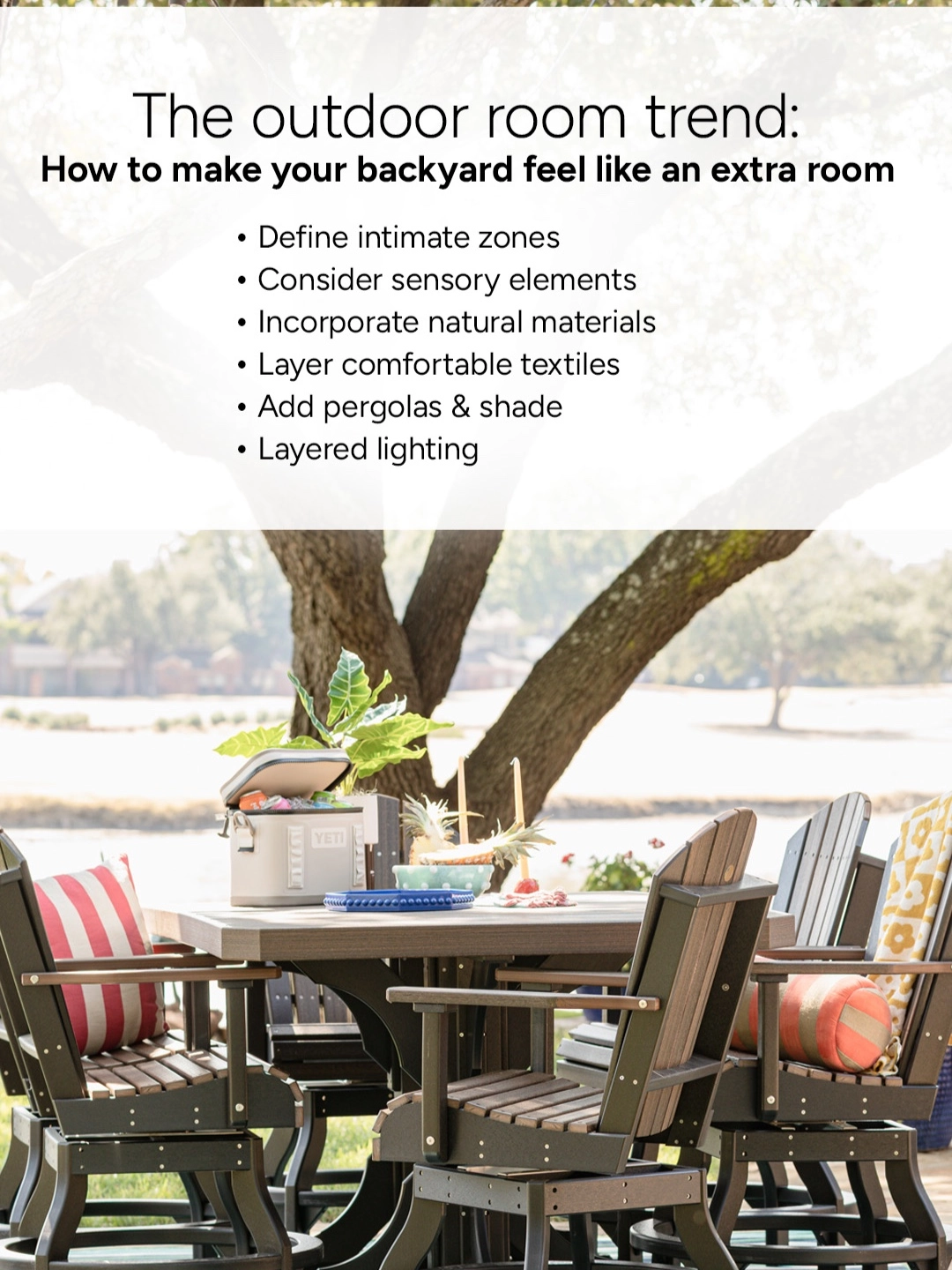
credit: @nfmpics
Sunscreen, pollen, and spills grind into outdoor fabric fast. A monthly cold wash keeps cream reading cream. Hot water fades terracotta piping in one cycle.
Remove covers and wash them cold on a gentle cycle with mild detergent. Air-dry in shade for 6 hours; direct sun fades wet fabric fastest. Refit covers while slightly damp for a smooth, tight finish.
| Textile | Wash Cycle | Dry |
|---|---|---|
| Cushion covers | Cold gentle | Shade, 6 hours |
| Throws | Cold gentle | Shade, flat |
| Napkins | Cold gentle | Shade, folded |
32. Oil Metal Frames and Check Umbrella Bases Each Season

credit: @kathykuohome
Outdoor metal rusts at every scratch and joint. A seasonal oil pass and base check keep frames and umbrellas safe for years. The whole pass takes one hour twice a year.
Wipe every metal frame joint with a cloth and light machine oil each spring and fall. Touch up chips with matching outdoor paint before oiling. Confirm the umbrella base holds its full 50 pounds of weight and every bolt sits tight.
Common Outdoor Patio Mistakes
| Mistake | Why It Hurts | Fix |
|---|---|---|
| Placing seats by morning shade | Afternoon sun empties the zone | Map shade at 5 p.m., Tip 2 |
| Chairs lined against the wall | Conversation dies across distance | Face seats 6-8 feet apart, Tip 7 |
| String lights carrying their own weight | Lines sag and sockets crack | Run a guide wire, Tip 12 |
| Cushions left out in rain | Foam mildews within weeks | Deck box every rain night, Tip 29 |
| Fixed watering all season | Spring drowns, summer starves | Adjust the timer monthly, Tip 30 |
| Fire pit close to seats | Heat and sparks drive guests back | Hold 36 inches clear, Tip 23 |
Outdoor Patio Ideas by Space and Situation
Small Patios and Balconies
Run two zones only: one seating pair on a 4-by-6 rug and the planter screen. Skip the dining table; the bar cart becomes the serving surface. The vertical planter from Tip 18 carries the whole green layer.
Large Patios and Decks
Add a second seating group and the fire pit circle from Tip 23. Repeat the planter trios at every corner for rhythm across the bigger slab. String lights run in two parallel lines at the same 8-foot height.
Shaded North-Facing Patios
Raise the cream share and add one extra lantern per zone. Choose shade plants, ferns and hostas, for the planter groups. The fire pit earns a central spot here; it supplies the warmth the sun does not.
Rentals With No-Drill Rules
Shade sails fix to weighted planter poles instead of walls. String lights hang from shepherd hooks at the same 8-foot line. Every piece in this guide lifts off clean at move-out.
Frequently Asked Questions
How do I make my patio look nice on a budget?
Zone the slab first, then anchor seating with a rug and repeat one palette three times per zone. String lights and planter trios give the biggest change per dollar. Tips 1, 6, and 16 set the full budget order.
How do I arrange furniture on a patio?
Face seats toward each other at 6 to 8 feet on an outdoor rug. Keep one 36-inch path clear from door to yard. Side tables land within arm’s reach of every seat, per Tips 6 to 8.
What is the best lighting for a patio?
Warm 2700K string lights at 8 feet, plus three floor lanterns at the seating zone’s corners. The two layers together read as a room after dark. Tips 12 and 13 give the exact spacings.
How do I add privacy to a patio without a fence?
Line the open edge with tall planters at 24-inch centers filled with grasses reaching 4 to 5 feet. The screen blocks seated sightlines while air moves through. Tip 15 gives the full build.
How do I shade a patio cheaply?
A tilted 9-foot umbrella covers a four-seat group, and a triangular shade sail cools the dining zone. Both together cost less than one pergola post. Tips 11 and 14 set the heights and angles.
How often should I water patio plants?
Run drip irrigation 20 to 30 minutes daily depending on season, at 6 a.m. Skip after half an inch of rain. Tip 30 gives the month-by-month settings.
What size rug fits under patio furniture?
A 5-by-7-foot rug anchors a standard seating group with every front leg on the weave. Dining runners extend 24 inches beyond the table on all sides. Tips 6 and 24 cover both zones.
How do I keep patio cushions from getting ruined?
Store them in a 75-gallon deck box every rain night and wash covers cold monthly. Air-dry in shade, never direct sun. Tips 29 and 31 set the full routine.
When should I set up my patio for the season?
Wash and zone the slab in early spring, then add shade and seating before the first warm weekend. Photograph the finished setup per Tip 28 so next year’s setup takes one afternoon.
Conclusion
Used patios run on one system: three clear zones on a sun-mapped slab, one locked palette repeated in every zone, and warm light at two heights after dark. The styling pass counts colors, tests the dusk view, and photographs the result. The care habits hold textiles, plants, and metal through the whole season. Measure the slab this weekend, map the 5 p.m. shade, and let the patio do the hosting.