
Cottage Garden Design: 30 Proven Ways to Build Romantic Abundance
Your cottage garden design succeeds or fails on structure beneath the abundance, disciplined color, and soil fed like a farm, not on how many flowers fit in a bed. This guide gives you 30 exact ideas, each with a measurement, a method, and a result you check with your own eyes. As professional cottage garden designers consistently find, romantic gardens that stay beautiful share three traits. The abundance is planted on bones, curving beds, paths, fences, and arches, because cottage charm is geometry wearing flowers. The planting is dense and layered, spires behind, billows in the middle, foam at the front, self-seeders stitching the gaps. And the palette is limited with intent, two or three families drifting everywhere, because abundance in every color reads as a seed catalog explosion. Work the sections in order and your garden builds from a site reading to the romantic abundance the style promises.
One number guides every purchase in this guide. Your full scheme lands between $100 and $8,000, and every tip below states its cost before you buy.
Before You Begin: Five Foundation Steps for Cottage Garden Design
Failed cottage gardens share one cause: flowers planted before the bones, the palette, and the soil are understood. This foundation section reads your site, draws your curves, and feeds your earth before the first purchase. Every later section builds on these five steps.
1. Read the Site Like a Cottage Gardener: Sun, Soil, and the House’s Style

credit: @lismaryscottage
The cottage style forgives many soils but no darkness: map the sun as the backyard guide teaches, six hours for the classic citizens, and note where part shade hosts the woodland wing. The house’s own architecture is consulted, brick, stone, and timber each flattering different palettes and fence styles. The reading is written in the file with the views from the kitchen window, the cottage garden being composed for its daily audience indoors.
Existing trees and old shrubs are inventoried as inheritance, cottage gardens treasuring the established over the new. Slopes and wet corners are marked as opportunities, steps and bog plantings being cottage classics. This survey takes an afternoon and prevents the style’s one unforgivable error: a cottage garden designed for a garden that does not exist.
| Site Law | Read | Treasured |
|---|---|---|
| Sun | Six hours for classics | Woodland wing in shade |
| House | Brick, stone, timber | Palette + fence |
| Inheritance | Old trees + shrubs | Established over new |
2. Draw the Curves: Beds, Paths, and Rooms on Paper First

credit: @peppertreeliving
The whole garden is drawn before a spade lifts: beds in deep sweeping curves, a path that wanders with destinations, and rooms divided by hedges, fences, or arches rather than by open lawn. Curves are generous, never wiggly, a cottage curve being a river’s line, not a worm’s. The drawing is transferred to the ground with a hose and lived with for two days, feet voting on the paper’s promises.
Beds are drawn deep, four to six feet for the layered abundance, shallow beds being the style’s silent killer. The lawn that remains is a shape with intention, a green room’s floor, not the garden’s leftover. This drawing is the design itself; everything after is execution.
| Curve Law | Drawn | Lived With |
|---|---|---|
| Beds | Deep sweeps, 4–6 ft | Hose on ground |
| Paths | Wandering, destinations | Two days of feet |
| Lawn | A shaped room floor | Not leftover |
3. Limit the Palette: Two or Three Color Families, Drifting Everywhere

credit: @themontydon
The palette is chosen in families: the classic pink, white, and lavender; the warm apricot, cream, and soft yellow; the cool blue, white, and silver. Every bed draws from the same families, drifts of color repeating like a song’s chorus. One guest color may visit a single bed by the file’s permission, tourism being charming and immigration being chaos.
Foliage colors count in the palette, silver and purple leaves being citizens with votes. The palette is photographed at the nursery before the car is loaded, impulse reds and oranges being returned to their shelves with love. This limitation is the style’s whole secret, abundance being easy and harmony being the art.
| Palette Law | Families | Guest Rule |
|---|---|---|
| Classic | Pink, white, lavender | One guest per bed |
| Warm | Apricot, cream, yellow | By file’s permission |
| Cool | Blue, white, silver | Foliage votes too |
4. Feed the Soil Like a Small Farm: Compost, Manure, and Deep Beds

credit: @arthurparkinson_
Cottage abundance eats: beds are dug or built deep with compost and well-rotted manure in farm quantities, the soil raised and enriched before the first perennial lands. Dense planting in poor soil is a hunger strike with flowers, the style’s lushness being a feeding program disguised as romance. A compost system is founded with the beds, the garden’s kitchen established before its dining room.
Soil is tested as the backyard guide teaches, its lessons filed. Mulch follows planting everywhere, the farm’s blanket. This feeding is repeated yearly, Tip 29, the cottage garden’s beauty being an annual subscription paid in compost.
| Feeding Law | Given | Founded |
|---|---|---|
| Beds | Compost + manure, deep | Before planting |
| System | Compost kitchen | With the beds |
| Blanket | Mulch everywhere | After planting |
5. Set an $8,000 Budget and Split It by Bones, Soil, and Plants

credit: @thewildlifetrusts
Cottage costs creep through plants bought before the bones and soil are funded. A split budget stops the creep at the first receipt. Bones and soil take the crown because abundance planted in poverty starves picturesquely, then plainly.
Divide $8,000 into $2,400 for bones and structures, $1,600 for soil and bed building, $2,800 for plants, and $1,200 for paths, fences, and finishing. Track every receipt against its column the same day. A column that hits its ceiling closes until something returns to the store.
| Line | Ceiling | Main Buys |
|---|---|---|
| Bones | $2,400 | Arches, hedges, trees |
| Soil + beds | $1,600 | Compost, building |
| Plants | $2,800 | Roses, perennials |
| Paths + finish | $1,200 | Fences, gravel, extras |
Structure and Bones: The Geometry Beneath the Flowers
Romance stands on carpentry. This section fences, arches, and paths it. Every structure reports to Tip 2’s curves.
6. Fence It With Picket or Hazel: The Cottage Boundary

credit: @serenaandlily
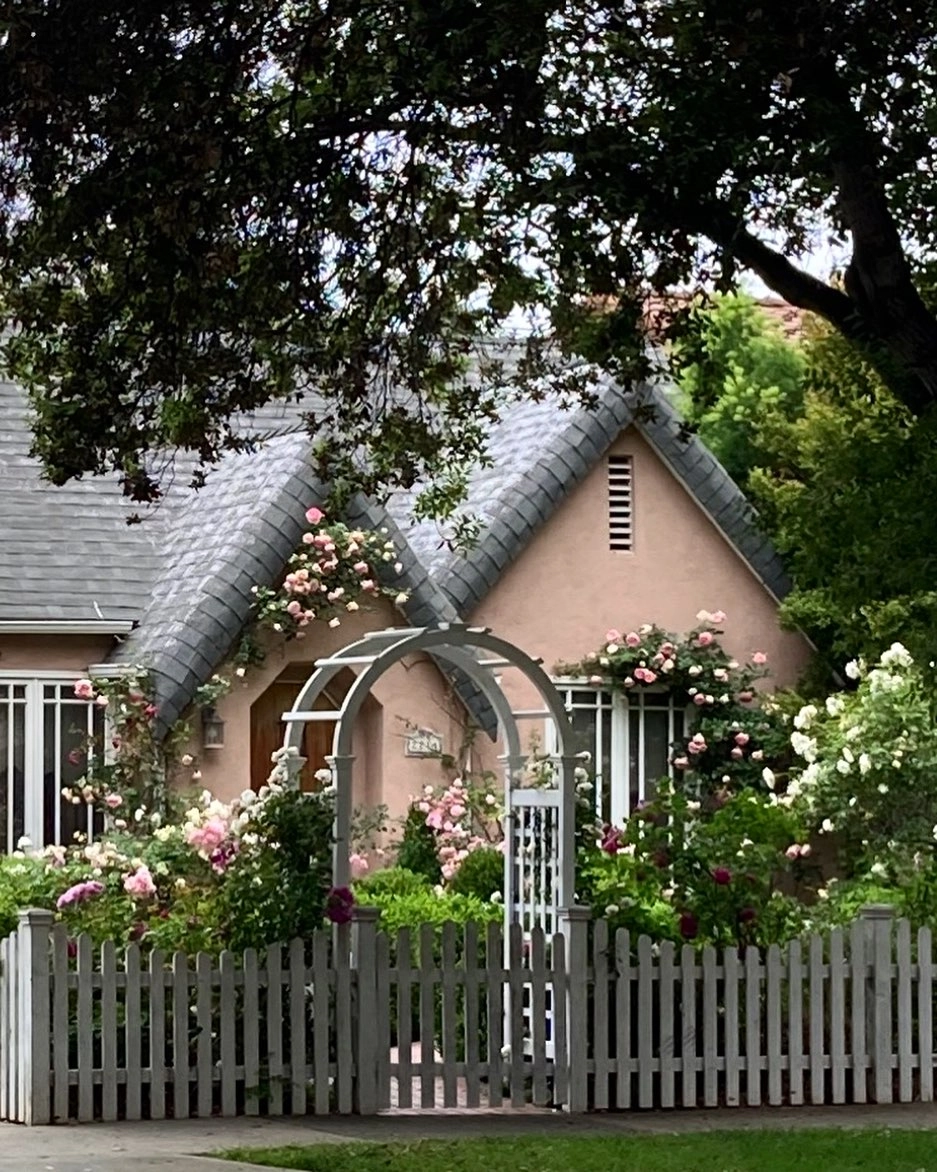
The boundary wears the style’s uniform: a picket fence at the front, painted white or left to silver, hazel hurdles and woven panels in the rustic register, low enough to chat over, the cottage fence being a social instrument. Gates are arched or ledged, hinges black, the entrance composed as the garden’s first sentence. Fence heights step with the garden’s rooms, privacy planted rather than built where the style argues.
Climbers are assigned to the fence from planting day, roses and clematis softening its lines within two seasons. Paint is renewed on Tip 30’s calendar, a shabby fence being charming exactly once. This boundary is the style’s signature photograph, and it is built before the beds it frames.
| Fence Law | Style | Social |
|---|---|---|
| Picket/hazel | White or silvered | Low, chat over it |
| Gate | Arched/ledged, black hinges | First sentence |
| Climbers | Assigned day one | Two seasons to soften |
7. Arch the Path: Roses and Clematis Over Every Threshold
credit: @jothompsongarden
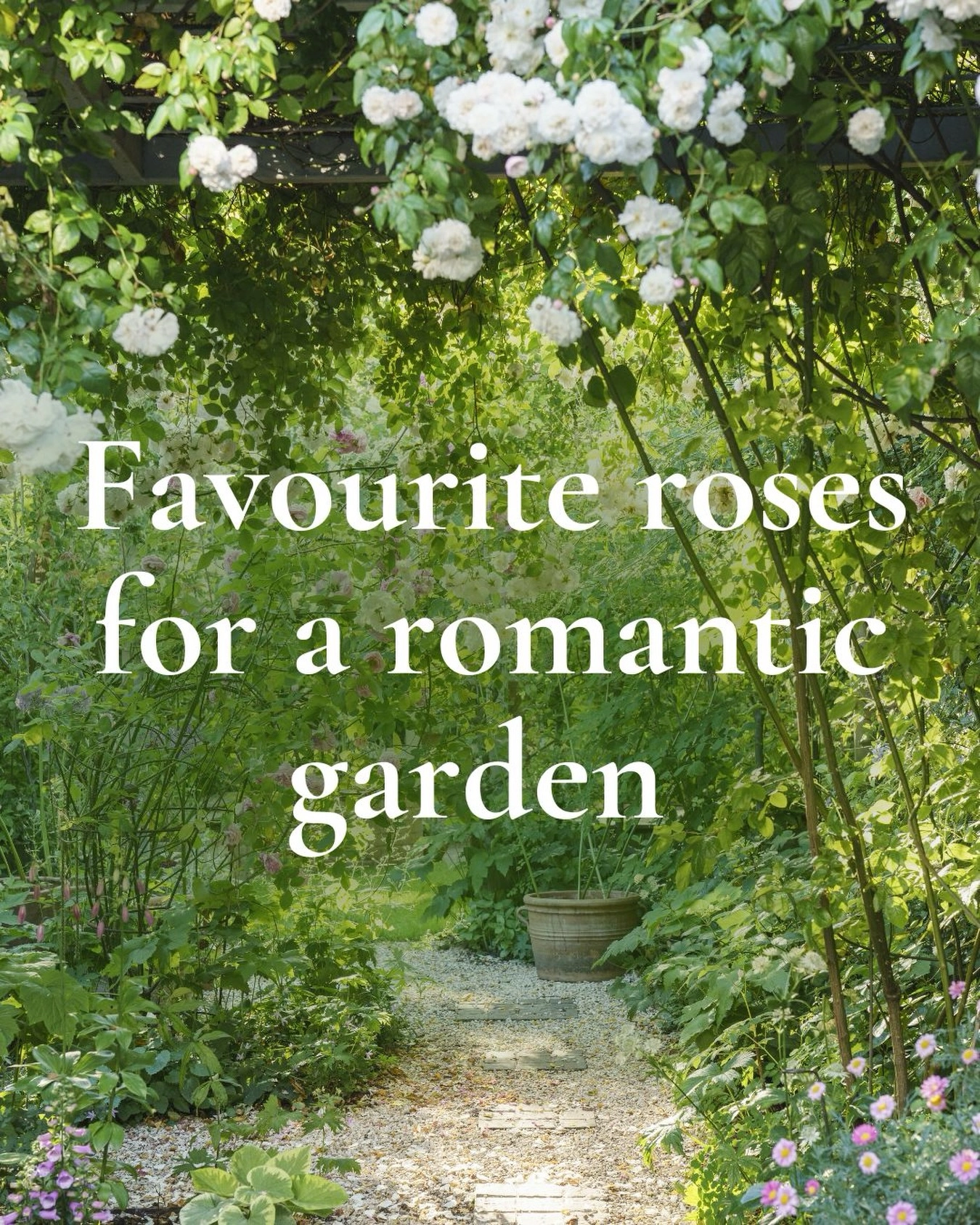
Arches stand at the path’s thresholds, the gate, the room divisions, the destination, clothed in climbing roses married to clematis, the classic cottage partnership, one feeding the other’s roots’ shade. Structures are anchored like furniture and sized for the mature climbers, a rose arch being a decade’s commitment in iron or timber. The arch’s planting pit is dug generously and fed like Tip 4, climbers being the hungriest citizens in the garden.
Pruning and tying-in are calendared, the arch’s shape being an annual negotiation. Scent is planted at face height by choice of variety, the threshold perfumed. This structure is the cottage garden’s doorway between rooms, and walking under roses is the style’s whole argument in one step.
| Arch Law | Stands At | Planted With |
|---|---|---|
| Thresholds | Gate, rooms, destination | Rose + clematis |
| Anchoring | Like furniture | Mature size in mind |
| Pit | Dug generously | Hungriest citizens |
8. Lay Wandering Paths: Gravel, Brick, and Stepping Stones in Grass

credit: @theblushingrosecottage
Paths wander by Tip 2’s drawing: gravel with stone or brick edging for the main walks, herringbone brick for the formal cottage, stepping stones through lawn and beds for the intimate routes. Widths run three feet for the main, two for the wanderers, wheelbarrows and baskets consulted. Path junctions get a widening, a small circle or a square, where a pot or a bench composes the pause.
Self-seeders are allowed to colonize the path’s edges, the style’s beloved softening, kept from the walking line by Tip 29’s editing. Gravel is raked and topped yearly, paths being maintained like rooms. This network is the garden’s circulation and its storytelling, every bend revealing a new composition.
| Path Law | Widths | Junctions |
|---|---|---|
| Main | 3 ft gravel/brick | Widened pause |
| Wanderers | 2 ft stones | Destinations only |
| Edges | Self-seeders allowed | Walking line kept |
9. Divide Rooms With Hedges, Trellis, and Flowering Screens

credit: @amazinggardenideas
Rooms are divided by green architecture: low box or lavender hedges for the formal divisions, trellis panels with climbers for the see-through walls, tall perennial screens for the summer-only borders. Each room takes a purpose and a palette variation, the kitchen garden room, the rose room, the seat’s room, discovery being the style’s engine. Divisions are planted at the bones stage, their maturity scheduled like the arches’.
A room’s entrance is framed, an arch or a gap in the hedge composed as a doorway. Small gardens take one division only, two rooms being plenty for wonder. This compartmenting is why cottage gardens feel larger than their fences, the eye never taking the whole estate at once.
| Room Law | Dividers | Purposes |
|---|---|---|
| Hedges | Box, lavender | Formal divisions |
| Trellis | Climbers | See-through walls |
| Small gardens | One division | Two rooms suffice |
10. Edge With Abundance’s Discipline: Lavender, Catmint, and Stone

credit: @mylavenderroselife
Bed edges are planted or built with intent: lavender and catmint billowing over the path in the classic spill, alchemilla’s foam at the front, or a stone and brick edge where formality argues. The edge is the bed’s handwriting, consistent through the whole garden. Spillers are cut back after their first flush for a second, the edge’s discipline being a calendar, not a fence.
The walking line stays clear at two feet, romance yielding to ankles by law. Edge plants repeat at every bed, Tip 13’s repetition beginning at the ground. This border discipline is what separates the cottage garden from the cottage chaos, the difference being visible from the gate.
| Edge Law | Spillers | Line |
|---|---|---|
| Lavender/catmint | Billow over path | Cut for second flush |
| Alchemilla | Front foam | Repeated everywhere |
| Walking | 2 ft clear | Romance yields |
11. Place the Sundial, the Bench, and the Birdbath: Cottage Punctuation

credit: @lukeedwardhall
The style’s classic punctuation is placed as focal points: a sundial or a birdbath at a path’s crossing, a bench in the rose room, an urn overflowing at the door. Each piece is singular per view, the backyard guide’s punctuation law in period dress. Materials are stone, weathered wood, and terracotta, plastic being the one accent the style cannot absorb.
Pieces are weathered honestly, new stone aged by planting around its base. The bench faces the best border at the best hour, Tip 1’s reading consulted. This punctuation gives the abundance its grammar, full stops where the eye rests.
Cottage Planting: The Abundant Layers
Planting is the style’s performance. This section spires, billows, and seeds it. Every plant reports to Tip 3’s palette and Tip 4’s soil.
12. Plant the Three Layers: Spires, Billows, and the Front Foam

credit: @gardenflowers688
Every bed is cast in three layers: the spires at the back, foxgloves, hollyhocks, delphiniums, and lupins giving vertical music; the billows in the middle, roses, geraniums, catmint, and phlox in mounded abundance; and the foam at the front, alchemilla, lavender, and low geraniums softening the edge. Heights descend to the path, no citizen hiding another. The casting is drawn on the plan at mature sizes, year three being the portrait the planting serves.
Spires are staked invisibly before they need it, the cottage garden’s elegance depending on nobody seeing the scaffolding. Billows are spaced to touch at maturity, soil showing being the style’s one true failure. This casting, repeated bed by bed, is the abundance’s entire method.
| Layer Law | Position | Citizens |
|---|---|---|
| Spires | Back | Foxglove, hollyhock |
| Billows | Middle | Roses, geraniums |
| Foam | Front | Alchemilla, lavender |
13. Drift and Repeat the Signature Plants: Roses, Lavender, and Geraniums

credit: @nigelslater
Signature plants repeat through every bed: the garden’s chosen roses, its lavender, its hardy geraniums, planted in drifts of three and five, so the whole garden reads as one composition. Varieties are limited, five roses repeated out-design fifty roses collected. Division and cuttings multiply the signatures free, Tip 31’s economy in its native garden.
A signature must thrive uncomplaining in the site’s truth, beauty with a work ethic. The file lists the signatures with their varieties, replacements bought true to name. This repetition is why cottage gardens photograph as paintings, the chorus returning in every scene.
| Signature Law | Chosen | Multiplied |
|---|---|---|
| Roses, lavender, geraniums | Thrive uncomplaining | Drifts of 3–5 |
| Varieties | Limited, repeated | True to name |
| Stock | Divisions + cuttings | Free forever |
14. Marry Flowers With Herbs and Vegetables: The Cottage Potager Heart

credit: @longhillcarriage
The cottage tradition mixes the useful with the beautiful: herbs in the flower beds, lavender and rosemary as structure, vegetables in the ornamental borders, kale’s architecture, chard’s stained glass, beans on the arches. One room, Tip 9, may be the formal potager, its beds edged in box or lavender. The mixing is composed, food plants cast like flowers by height and color, the harvest walking through a painting to reach the kitchen.
Sage, thyme, and chives earn permanent citizenship at the edges, their flowers feeding the bees between their harvests. A fruit tree, espaliered or cordoned, takes a fence as the potager’s wall of blossom and dessert. This marriage is the style’s oldest wisdom, the cottage garden having fed its household for centuries before it posed for photographs.
15. Let the Self-Seeders Stitch: Foxgloves, Aquilegia, and Honest Forget-Me-Nots

credit: @home_gardening86
Self-seeders are the style’s embroidery: foxgloves, aquilegia, forget-me-nots, poppies, and nigella allowed to sow themselves into gaps, their seedlings edited by Tip 27’s hand, kept where they compose, moved or removed where they riot. Seed heads are left standing until the sowing is done, the gardener’s patience being the seed bank’s whole security. One year’s seedlings are next year’s free drifts, the garden funding its own abundance.
The best seedlings are marked with a pebble at discovery, protected from the hoe’s enthusiasm. Varieties cross and surprise, the garden co-authoring its palette within Tip 3’s families. This managed wildness is the cottage garden’s soul, control and surrender in one gesture.
16. Sequence the Bloom: A Relay From Snowdrops to Dahlias
credit: @glitter_fig
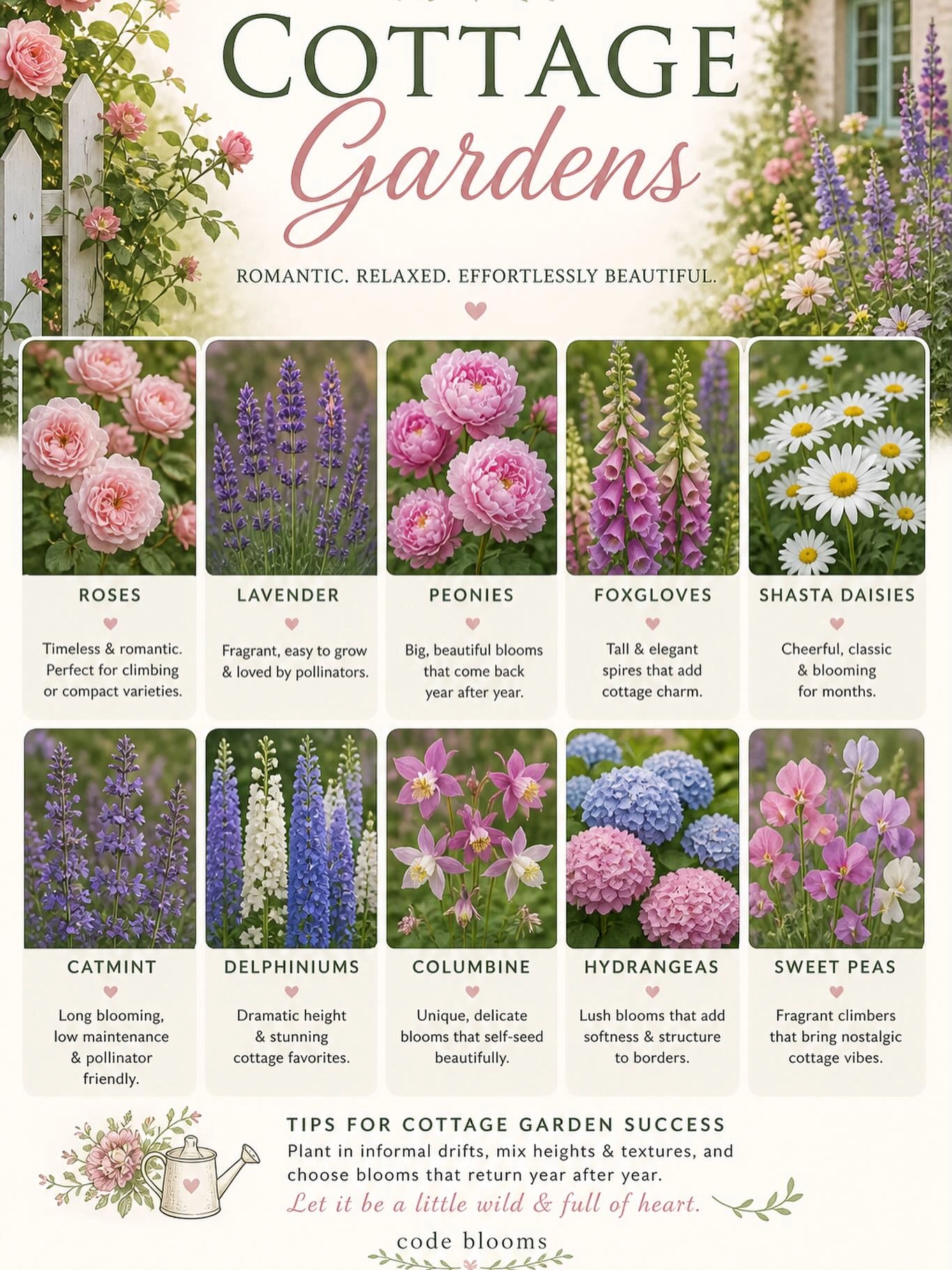
The planting is scheduled as a relay: snowdrops and hellebores opening, tulips and aquilegia following, roses and delphiniums at the high summer peak, dahlias and asters closing into autumn’s seed heads. Every bed holds at least three relay runners, no bed ever entirely between acts. The calendar is written in the file bed by bed, gaps filled at the autumn planting with bulbs and biennials.
Biennials, foxgloves and sweet williams, are sown yearly in their corner, the relay’s farm team. Dahlias are lifted or mulched by the climate’s law, their return calendared. This succession is the difference between a cottage garden with a fortnight and one with a year.
17. Plant for Scent and Evening: Roses at the Seat, Stocks at the Door

credit: @thefarmhouseflowerfarm
Scent is planted by address: the most fragrant roses at the bench and the arch, night stocks and nicotiana at the door and the evening seat, lavender at the path’s edge where ankles brush it into perfume. Evening flowers run pale, white and cream glowing at dusk for the moths and the humans alike. The scent map joins the file, varieties chosen by nose at the nursery, labels being poor perfumers.
One scent per room is the dose, perfumes duetting only where the gardener has tested the marriage. The kitchen window’s sill takes a scented pelargonium or two, the indoor audience rewarded. This planting is invisible in photographs and unforgettable in person, which is the cottage garden’s whole hierarchy of values.
Cottage Features and Furniture: Rooms to Linger In
Features give the romance its occasions. This section seats, waters, and houses it. Every feature reports to Tip 9’s rooms.
18. Set the Rose Room’s Bench and the Tea Table: Furniture in Period
credit: @clarefeldman10
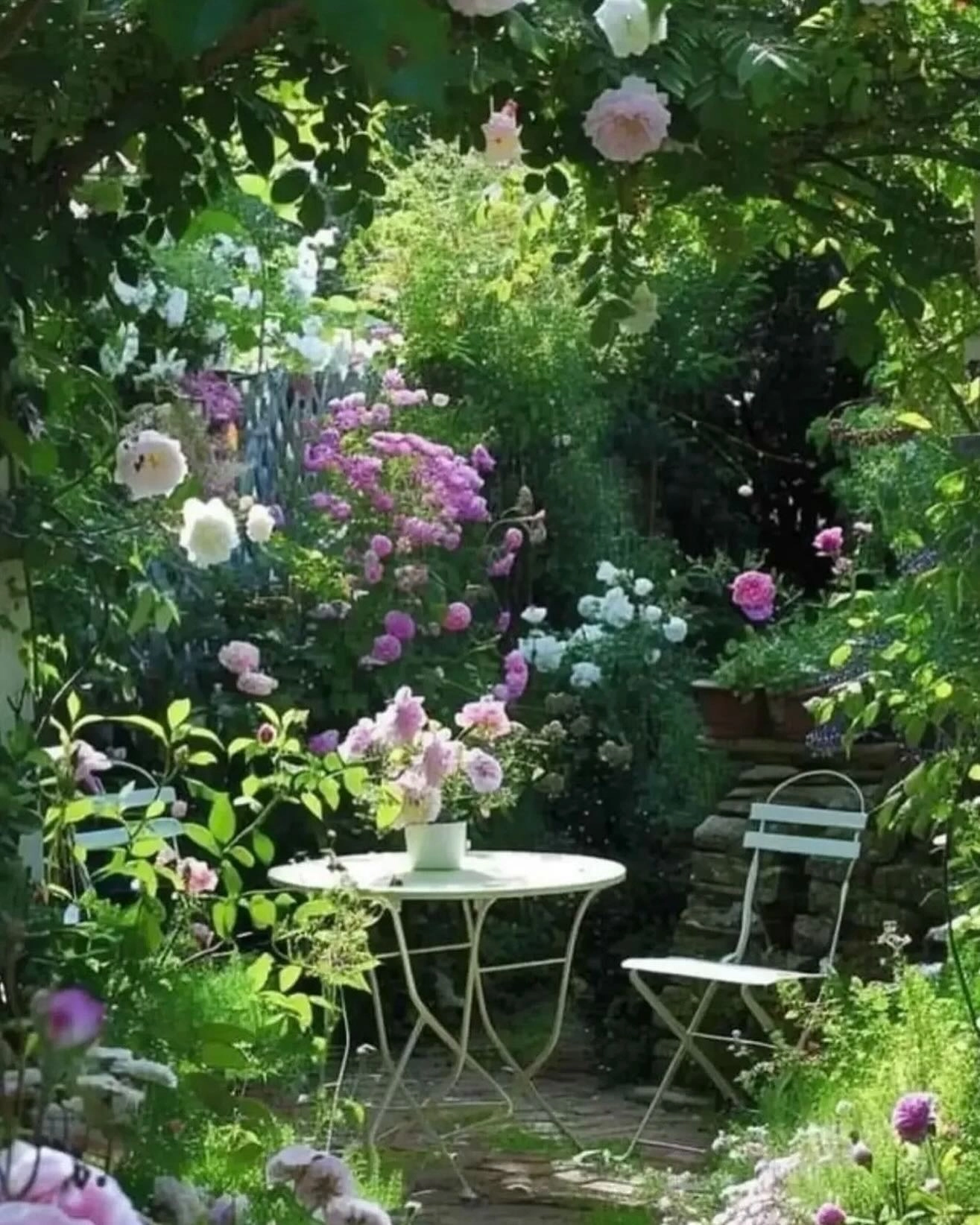
Furniture wears the style: a wooden or iron bench in the rose room, a small tea table and two chairs on a gravel circle, a hammock between the old trees where fortune allows. Pieces are weathered, painted in the palette’s greens and creams, or left to silver honestly. Every seat faces a composed view and stands on Tip 8’s paths, a seat off the network being a seat unvisited.
Cushions live in a bench box by the door, beauty surviving weather by logistics. A side surface for the teapot is non-negotiable, the cottage ritual having standards. This furnishing turns the garden from a painting into a residence, which is the style’s founding intention.
19. Add the Water’s Small Music: Birdbaths, a Tiny Pond, and the Watering Can as Art

credit: @lismaryscottage
Water enters at cottage scale: birdbaths at the crossings, a half-barrel pond with a miniature lily where safety allows, a wall fountain’s murmur at the seat. The watering can, galvanized and handsome, is decor between its duties, the style honoring its tools. Moving water is tuned soft, the cottage register being a murmur, not a fanfare.
Birdbaths are scrubbed on Tip 29’s round, hospitality’s hygiene. Barrel ponds are netted or ramped for the wildlife’s safe exit, kindness engineered. This water is the garden’s wildlife theater and its coolest corner, both priceless at cottage prices.
20. House the Tools Beautifully: The Shed, the Potting Bench, and the Cold Frame
credit: @sherrieanngibson
The backstage wears the style too: the shed painted in the palette’s deep green or cream, a potting bench with its pots stacked as still life, a cold frame raising the relay’s farm team. Tools hang in order, the workshop’s tidiness being a cottage virtue disguised as charm. The shed’s wall takes a climber, even the infrastructure flowering in this garden.
Compost bins hide behind a hazel hurdle, the farm’s engine screened in period materials. Seed storage and the file live at the bench, the garden’s office. This backstage beauty is why cottage gardens photograph well from every angle, no corner apologizing.
21. Light the Romance Sparingly: Lanterns, Candles, and the Moon’s Garden

credit: @luybizan
Evening light stays in period: lanterns at the seat and the gate, candles in jars on the tea table, one string of warm lights in the arch where festivity lives, and the pale flowers of Tip 17 doing the rest by moonlight. Light is sparse and warm, the cottage night being mostly darkness with punctuation. Solar lanterns serve the far rooms, their glow kept amber and gentle.
The moon garden corner, white flowers and silver foliage at the evening seat, is planted as deliberately as any bed. Timers and candles retire at a civilized hour, neighbors and moths respected. This restraint is the style’s evening elegance, a garden that whispers after dark.
Cottage Garden Styling and Finishing Touches
The garden is built and planted. This section runs the styling pass: density edits, containers, and the gate test. A cottage garden is finished when its abundance looks inevitable rather than accidental.
22. Fill Every Gap: Density as the Style’s Signature
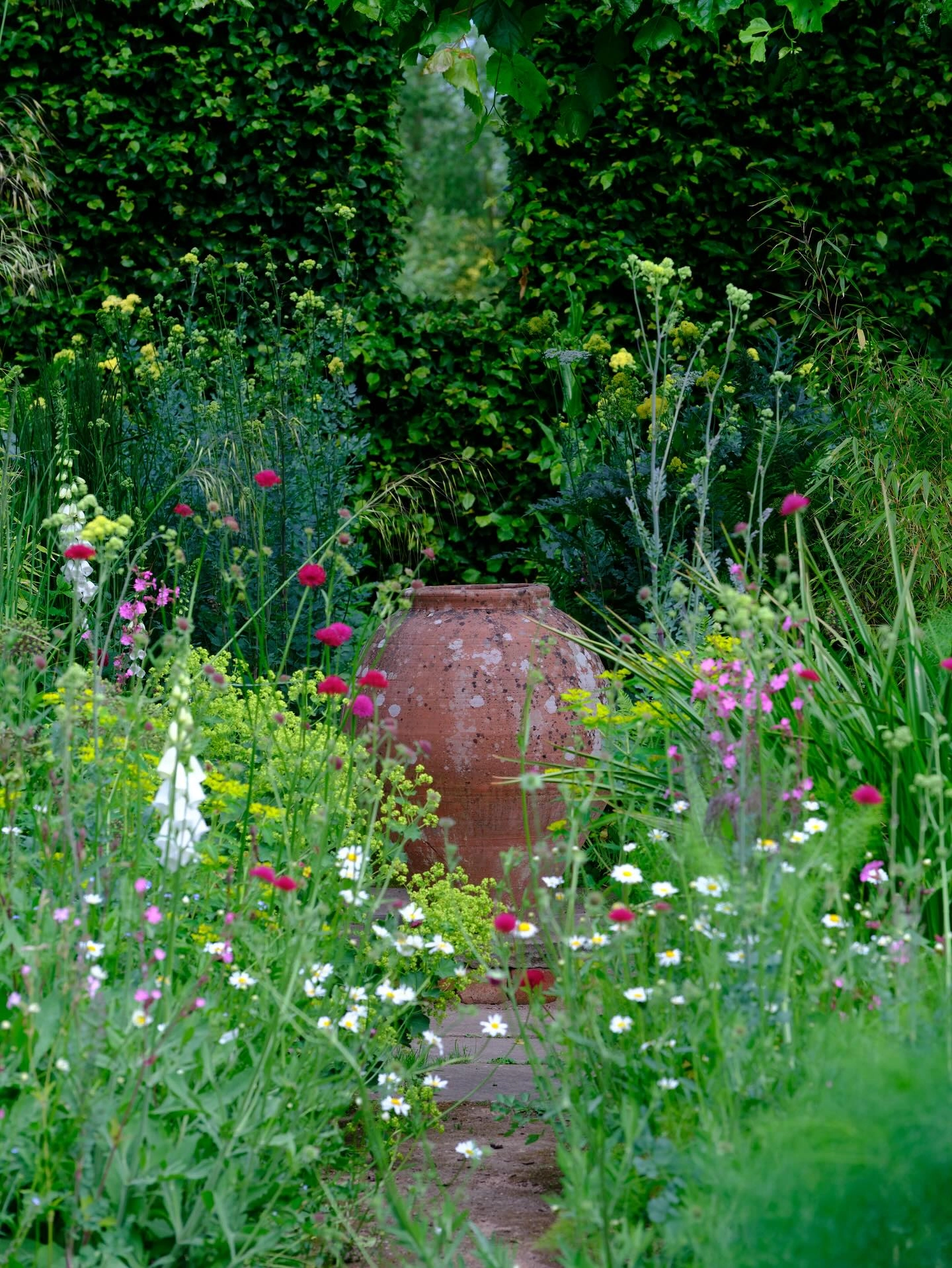
credit: @themontydon
Density is audited from the paths: any soil showing between plants in high summer is a gap to fill with the signatures’ divisions, a self-seeder’s transplant, or a pot sunk into the bed for the season. Planting grows together until leaves touch, weeds losing their light and the style gaining its lushness in the same gesture. Temporary annuals, cosmos and nicotiana, fill the young garden’s gaps while the perennials mature, Tip 28’s patience employed as a planting plan.
Overcrowding is the opposite failure, edited by division rather than celebrated, air being a plant nutrient too. The audit is repeated monthly, gaps moving as plants grow at their different speeds. This fullness is the photograph’s secret, abundance being a coverage statistic before it is a feeling.
23. Style Containers the Cottage Way: Terracotta, Enamel, and Old Buckets

credit: @lovely.harbor
Containers at the door, the steps, and the seat wear the period: terracotta in clusters, enamel jugs and old buckets planted, a wheelbarrow of flowers as the mobile bed. One material family per cluster, sizes descending, planting in the palette’s families. Containers take the tender and the annual stars, their mobility serving Tip 16’s relay at the garden’s most-seen addresses.
Drainage is drilled into every found vessel, whimsy obeying botany. Pots are watered on the round, containers being the garden’s thirstiest citizens. This styling extends the beds onto the hard surfaces, the cottage abundance flowing to the very doorstep.
24. Compose From the Gate and the Window: The Two Great Views

credit: @1988official
The garden’s two great compositions are checked from their galleries: the gate’s first view, arch, path, and the best border arranged as the opening sentence; and the kitchen window’s daily view, layers and drifts composed for the seated audience. Heights and colors are adjusted from these viewpoints, plants being moved for the picture like furniture. Winter’s views are composed too, the bones and the bird table carrying January.
A view that fails is fixed at its foreground first, near planting governing the whole picture’s depth. The gate view gets the palette’s best drift, first impressions being planted like everything else. This discipline is why cottage gardens feel like paintings you walk into, because they were composed like them.
25. Photograph the Garden and Keep the Cottage File

credit: @themontydon
The garden is photographed monthly from the gate, the window, and each room, and the file is completed: the drawing, the palette, the signatures with varieties, the relay calendar, and the notes on what self-seeded where. The file is the garden’s memory in a style that reinvents itself yearly from its own seed. Photographs catch the drift that thins and the arch that leans while fixes are one season away.
Seed saved is labeled with its bed and year, the file’s bank. Failures are recorded with their autopsies, cottage lessons being compost for the mind. A garden with a file improves yearly; without one, it re-learns the same June every year.
26. Edit the Exuberance: The Monthly Walk With Secateurs and a Basket
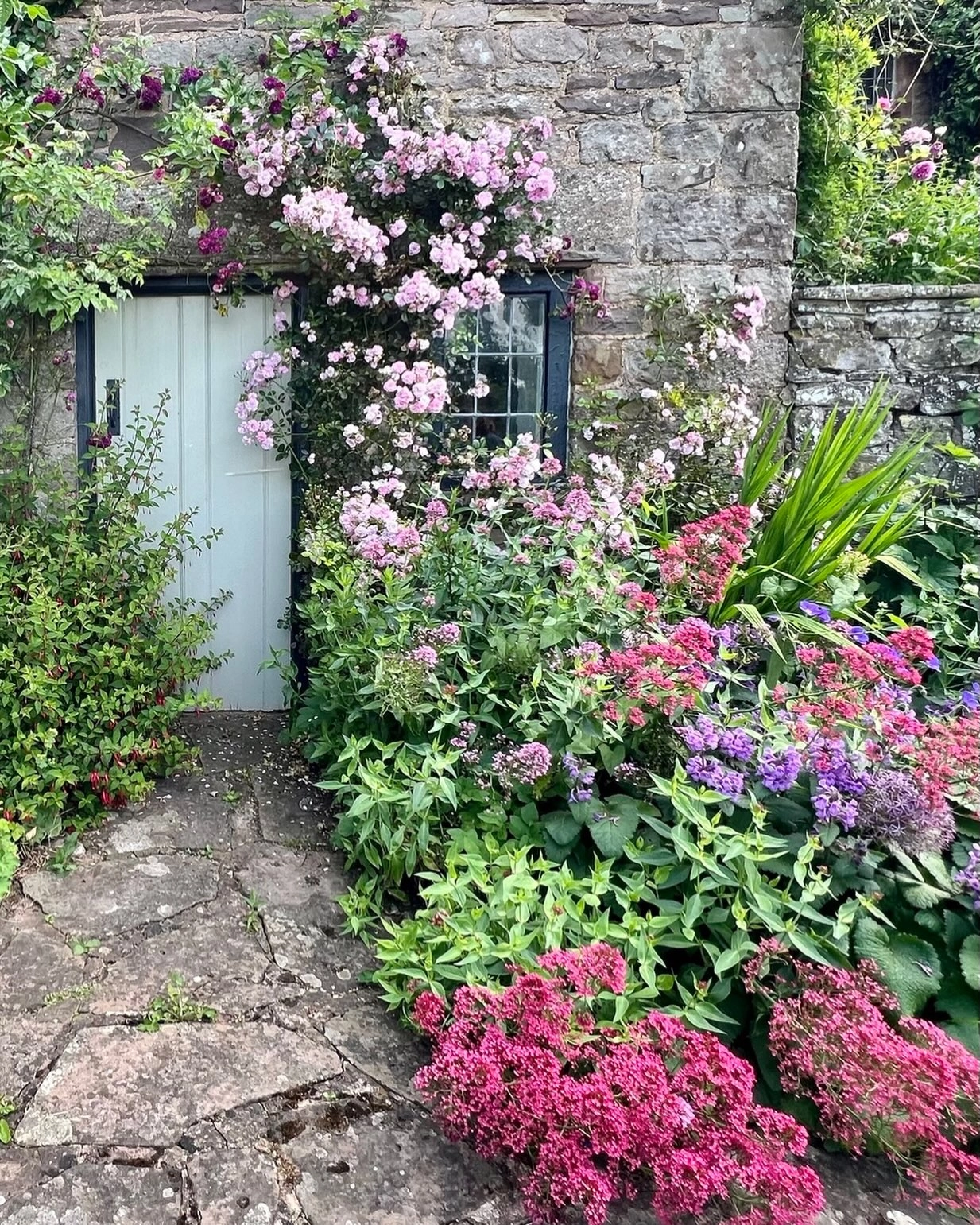
credit: @curatedgardenviews
Monthly, the maker walks with secateurs and a basket: deadheading the repeat bloomers, cutting back the edge spillers to their second flush, staking the spires that lean, and removing the self-seeders that riot. The walk is the style’s true maintenance, little and often, an hour of editing preserving the romance from entropy. Findings feed the file and the compost in equal measure.
One bed per walk gets the deep edit, rotation keeping every bed quarterly groomed. The basket’s contents are the garden’s diary in vegetable form. This rhythm is why some cottage gardens stay romantic all summer and others peak for one photographed week in June.
27. Know the Style’s Limits: When Cottage Becomes Chaos

credit: @thegardeningspirit
The style is audited honestly each year: beds where the layers collapsed into a scramble, colors that immigrated without permission, paths disappearing under the beloved spill. Corrections are made at the autumn edit, plants moved, divided, or given away, the palette’s constitution re-read aloud. Chaos is abundance without the bones showing, and the bones are re-exposed with love and a spade.
A garden that needs a full rescue gets it room by room, never all at once, the patient method of Tip 9’s own divisions. The gardener’s taste evolving is recorded as amendments, not failures. This honesty keeps the romance a style for decades, rather than a phase the garden survives.
Cottage Garden Care, Feeding, and Seasonal Rounds
Abundance is a feeding and editing program. These habits mulch, prune, and schedule it. Each one protects the layers and the relay.
28. Respect the Three-Year Maturation: Fill, Wait, and Photograph
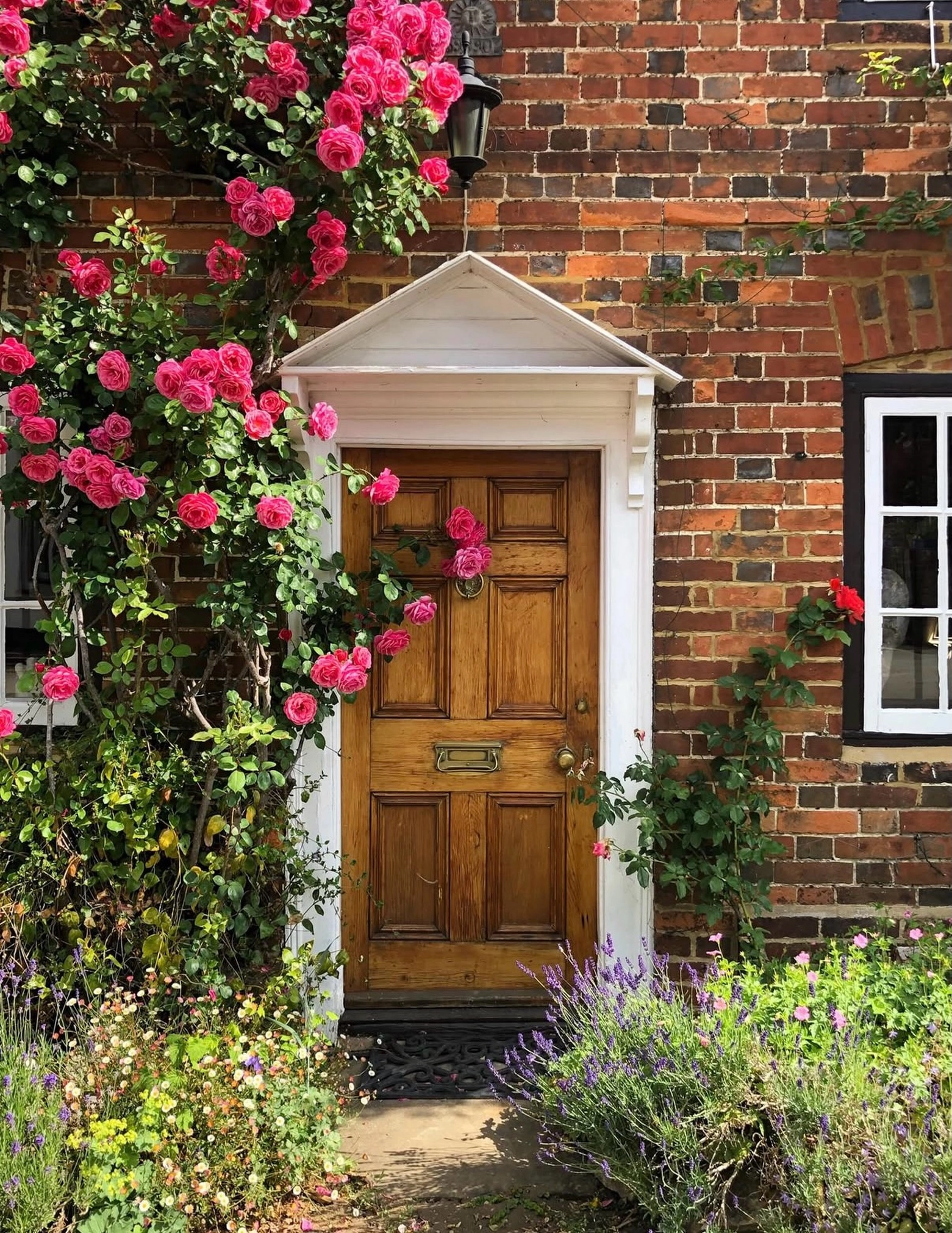
credit: @thebest_windowsdoors
Cottage perennials keep the three-year calendar: sleep, creep, leap, the beds filling by division and self-sowing rather than by panic buying. Year one’s gaps take annuals, year two’s take divisions, year three’s take applause. Photographs from the same gates each June prove the progress on the days the gardener doubts it, growth being invisible at daily range.
Replanting a young cottage bed is the style’s costliest impatience, the file’s calendar defending the plan. Roses and climbers are judged at year three earliest, their roots being the real first act. This patience, planted like everything else, is the cottage garden’s final design material.
29. Run the Cottage Rounds: Mulch, Deadhead, Stake, and Sow
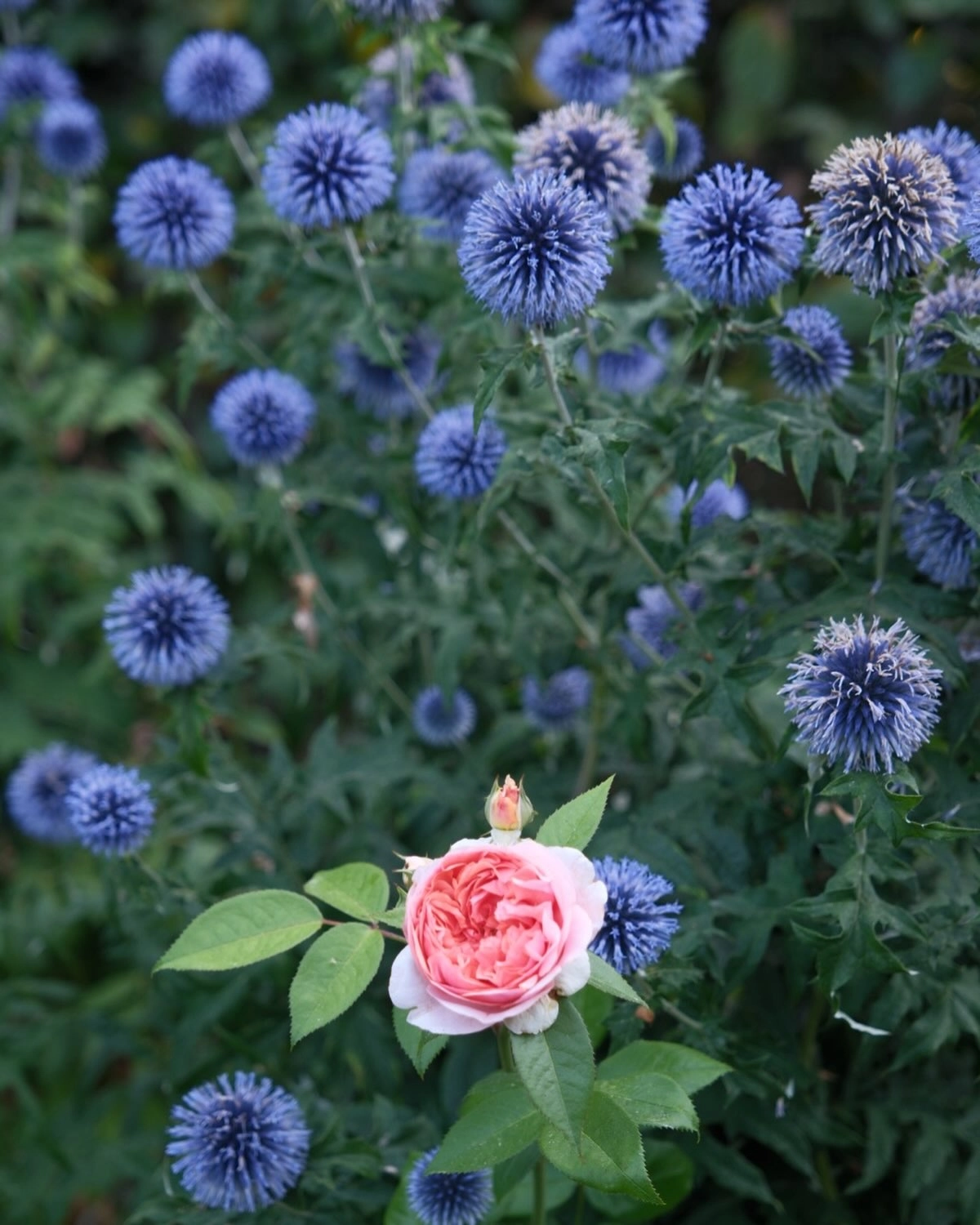
credit: @themontydon
The year runs in rounds: spring’s mulch and edge renewal, the first staking, and biennial sowing; summer’s deadheading, cutting back, and watering deep in drought; autumn’s bulb planting, seed saving, and the great edit; winter’s rose pruning, structure repairs, and planning by the fire. Each round is written in the file with its month, abundance being a calendar disguised as a garden.
Watering in drought goes to the roots of the young and the precious, established cottage citizens being famously stoic. The rounds attach to the month’s first Saturday, habit riding on habit. This rhythm is the whole maintenance secret, small rounds preventing the rescue weekends that break gardeners.
30. Feed and Renew Yearly: Compost, Roses’ Dinner, and the Fence’s Paint
credit: @susanbranchauthor
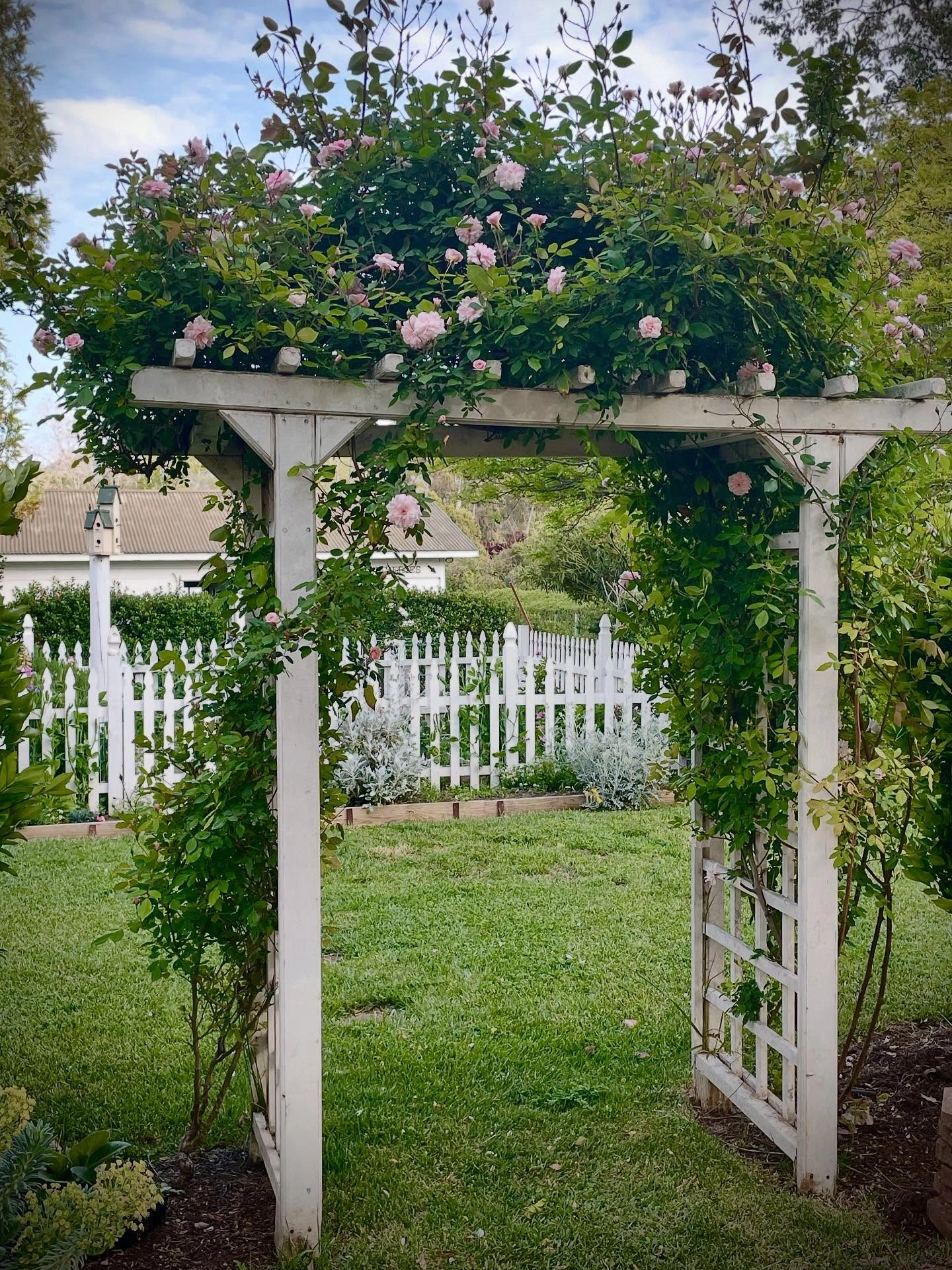
Yearly, the farm is fed: compost or manure mulched over every bed in autumn or spring, roses given their dedicated feed at pruning and after the first flush, and containers fed through their season, pots eating like the athletes they are. Structures are renewed on the same calendar, fence paint, arch bolts, and path gravel topped before they ask loudly.
A starving cottage garden thins from the middle out, the file’s feeding record consulted before any plant is blamed. Paint and preservative keep the bones’ decade-long promises. This annual renewal is the subscription the romance runs on, paid gladly by everyone who has seen June in a fed garden.
| Habit | Task | Frequency |
|---|---|---|
| Edit walk | Deadhead, stake, cut back | Monthly |
| Rounds | Mulch, sow, prune, plant | Seasonal |
| Feed | Compost everywhere, roses twice | Yearly |
| Renew | Paint, bolts, gravel | Yearly |
Common Cottage Garden Design Mistakes
| Mistake | Why It Hurts | Fix |
|---|---|---|
| No bones, only flowers | Chaos by July | Curves, fences, arches first, Tips 2, 6–7 |
| Every color everywhere | Seed-catalog explosion | Two–three families, Tip 3 |
| Shallow ribbon beds | Layers cannot stack | 4–6 ft deep, Tip 2 |
| Poor soil, dense planting | A hunger strike | Feed like a farm, Tip 4 |
| Self-seeders unedited | Riot, not embroidery | Edit monthly, Tips 15, 26 |
| Judging in year one | Costly impatience | Three-year rule, Tip 28 |
Cottage Garden Design Ideas by Scale and Register
Classic Rose and Lavender Cottages
Picket fences, rose arches, lavender edges, the pink-white-lavender palette. These gardens win on romance, the style’s postcard executed with bones and discipline. Their discipline is Tip 3’s palette, the postcard being a limited edition by design.
Potager and Working Cottages
Flowers married with food, espaliered fruit, herb-edged beds. These gardens win on dinner, beauty that feeds its household nightly. Their discipline is Tip 14’s composition, vegetables cast like flowers by height and color.
Small and Courtyard Cottages
One division, vertical climbers, containers at the door, a single arch. These gardens win on intensity, the style distilled to its essence in a courtyard’s compass. Their discipline is Tip 9’s restraint, two rooms and a palette of two families sufficing entirely.
Shady Woodland Cottages
Hellebores, foxgloves, ferns, and white evening flowers under old trees. These gardens win on peace, the cottage style in its green, cool register. Their discipline is Tip 1’s honest reading, shade planted with its own stars rather than the sun’s exiles.
Frequently Asked Questions
What makes a garden a cottage garden?
Informal abundance planted on real structure: deep curving beds, wandering paths, fences and arches, plants in layered drifts of a limited palette, flowers mixed with herbs and food, and self-seeders stitching the gaps. Tips 2, 3, and 12 state the method; without the bones it is only a crowd of flowers, and without the abundance it is only a fence.
What flowers are essential in a cottage garden?
Roses first, then the spires, foxgloves, hollyhocks, delphiniums, the billows, hardy geraniums, catmint, phlox, and the foam, alchemilla and lavender, with self-seeders, aquilegia, poppies, nigella, embroidering between. Tips 12 to 15 cast them; choose varieties that thrive in your soil and repeat them in drifts rather than collecting singles.
How do I start a cottage garden on a budget?
Build one bed deeply and well, fed with compost, planted with divisions, cuttings, and seed, self-sown foxgloves and annual cosmos filling year one, and extend a room at a time by the file’s plan. Tips 4, 15, and 31 in the backyard guide’s economy apply; the style was invented by households without budgets, its true currency being seed, patience, and sharing.
What colors work best in cottage planting?
Two or three families drifting everywhere: pink, white, and lavender for the classic; apricot, cream, and soft yellow for the warm; blue, white, and silver for the cool. Tip 3 limits the palette; abundance in one palette reads as romance, while abundance in every color reads as an accident at the seed factory.
How wide should cottage beds and paths be?
Beds four to six feet deep so the three layers can stack, main paths three feet in gravel or brick, wandering paths two feet in stepping stones. Tips 2 and 8 lay them out; shallow beds are the style’s silent killer, and paths are drawn as generous curves with a hose before a spade touches earth.
Can I mix vegetables into a cottage flower garden?
Yes, it is the style’s oldest tradition: herbs at the edges, kale and chard cast by color, beans on the arches, an espaliered fruit tree on the fence, or one formal potager room. Tip 14 marries them; compose food plants like flowers, by height and color, and the harvest walks through a painting.
How do I keep a cottage garden from looking messy?
Keep the bones visible and the edges crisp, edit monthly with secateurs, cut back spillers after their first flush, limit the palette, and audit yearly for layers that collapsed into scramble. Tips 10, 26, and 27 run the discipline; cottage charm is geometry wearing flowers, and the geometry must keep showing through.
How long does a cottage garden take to look established?
Three years by the rule of sleep, creep, leap, with annuals and self-seeders filling the young gaps and roses and climbers judged at year three at the earliest. Tip 28 keeps the patience; the garden funds its own filling by division and seed, so the waiting years are busy rather than bare.
What do I plant for scent in a cottage garden?
The most fragrant roses at the bench and arch, night stocks and nicotiana at the door, lavender where ankles brush the path’s edge, and pale evening flowers for the moon corner. Tip 17 plants scent by address; one perfume per room is the dose, and varieties are chosen by nose at the nursery, not by label.
Conclusion
A cottage garden that stays romantic runs on one system. The curves are drawn, the palette is limited, and the soil is fed like a farm, because abundance is a feeding program disguised as romance; the bones are built, fences, arches, rooms, and edges, and the planting is cast in layers and drifts with self-seeders stitching, so every bed composes from the gate and the window; and the rounds are kept, edited monthly, fed yearly, matured patiently by the three-year rule, its file recording every drift and autopsy, so the garden improves like a story being revised by its own author. Lay a hose in one generous curve this week along your plainest fence, live with it for two days, and take the before photo from the gate.